At a glance
- What changed
- An additional route for funding the app.
- Who it affects
- Eligible users with the supported assets.
- When
- Announced live on 28 September 2026.
Aave App partner offer and conditions ↓
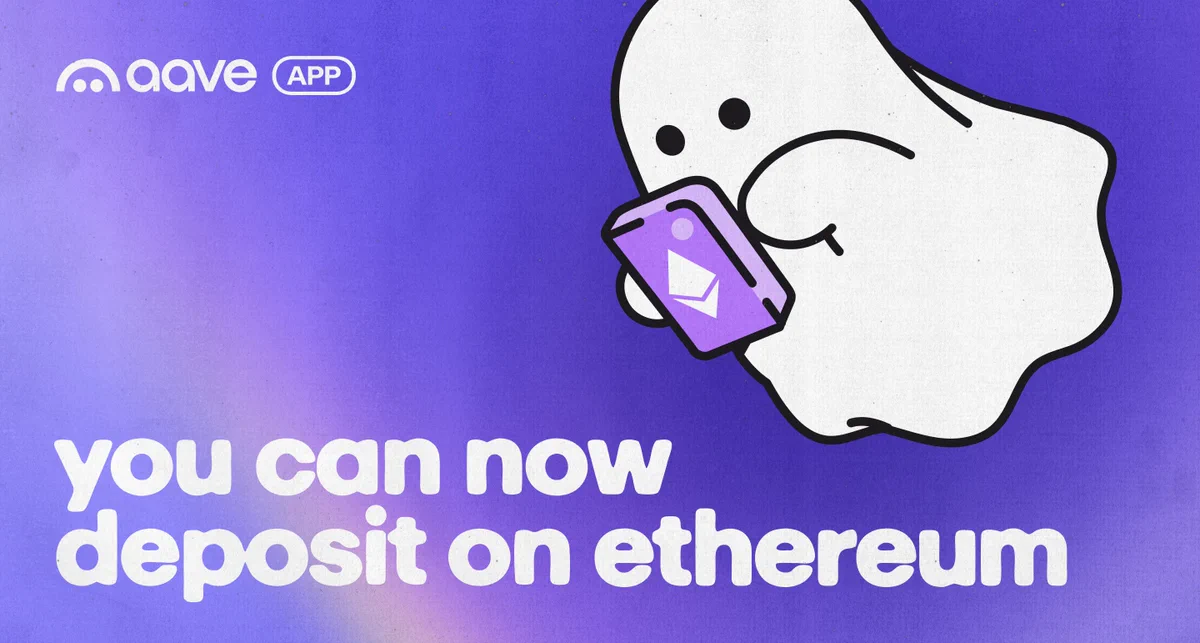
Ethereum deposits are now available in the mobile app
Aave announced on 28 September that its mobile app now accepts USDC and USDT deposits sent through Ethereum. For someone already holding either token on that network, the update adds a way to fund the app from those holdings.
The useful change is a funding route. For users whose money is already on Ethereum, it creates another option to consider when moving supported tokens into the app. The deciding information remains the deposit instruction inside their account: the asset they want to send, the network it travels on, and the address where it should arrive.
[1]Match the asset, network and destination
Aave’s disclosures instruct users to send supported stablecoins on the correct supported network to the address supplied by the app.
For this update, USDC or USDT identifies the asset, while Ethereum identifies the network. The destination is the receiving address shown for the relevant deposit in your own app. Treat those as three fields that must agree with the sending service. The address in someone else’s screenshot is not your deposit instruction.
Imagine Maya holds 300 USDC and is deciding how to send it. A withdrawal screen showing USDC and Ethereum describes the route covered by this announcement, provided the receiving details also match. A screen showing USDC and another network needs a separate compatibility check. The token name has stayed the same, but the delivery route has changed. The post does not establish support for every network offered by the sending service.
[1] [3] [4]Understand what happens after funds arrive
Aave’s account explainer describes an embedded smart account: a programmable wallet inside the app. Signup uses an email address or phone number and a password. Users grant limited permission for stablecoins arriving in that account to move into the vault, the software used for the app’s earning activity, without returning to initiate that step manually.
This explains why “I sent it” and “the app shows my funded position” describe different stages. The sending service can show a submitted transfer before the receiving workflow has finished. When checking a transfer, compare the asset, network, destination and amount with the original instruction, then distinguish the transfer’s status from the balance currently displayed. The announcement gives no fixed completion time.
[1] [2] [3]Check the actual transfer cost
Aave’s terms describe possible blockchain and protocol charges, while independent services can impose their own charges. Aave’s account software can sponsor gas for some activity, but that does not establish that an external wallet or exchange sends funds for free. Gas means the cost of executing a blockchain transaction.
For an invented example, a 300-token transfer with a separately deducted three-token fee would leave 297 tokens if that fee comes out of the amount being sent. That is a 1% deduction. This is arithmetic, not an Aave quote. Read whether the sender deducts a fee from the transfer or charges it separately; those arrangements produce different received amounts even when the displayed starting amount matches.
[2] [3]The sending service and the receiving app have different roles
Someone starting from an exchange uses that service’s withdrawal process, while someone starting from a personal wallet uses its sending process. Both need the destination supplied by the receiving app. The sender’s list of networks describes the choices it offers; it does not prove that every choice is accepted at the destination.
For example, if the sender offers two routes for the same token, a lower quoted charge on one route is not enough to select it. Compatibility comes first. Compare costs only after establishing that the route matches the receiving instructions. This is a practical consequence of adding network support, rather than a ranking of wallets or exchanges.
[3]Access requirements still apply
Aave’s terms require users to meet the higher of age 18 or their local age of majority, have legal capacity, and satisfy applicable jurisdiction and sanctions restrictions. The network announcement does not establish availability in every country.
Before sending, confirm the receiving details in the app and review the sender’s final transaction summary. Blockchain transfers are generally irreversible once confirmed. For a later withdrawal, Aave’s account documentation describes pre-authorizing the destination using a one-time verification code. That is a separate account control, rather than a promise that the original deposit route automatically configures every future withdrawal.
[2] [3]Walk through a deposit check
Highlight a stage. All three explanations remain visible.
- 1. Receiving details
Start inside your own account
Use the deposit details displayed for the relevant asset and network in your app. Another person’s address is not your destination.
- 2. Route details
Compare three fields
Match the token, network and receiving address. A familiar ticker alone does not establish the route.
- 3. Final amount
Read the sender’s quote
In the hypothetical example above, deducting three tokens from 300 leaves 297. Check whether a quoted cost is deducted or charged separately.
Educational walkthrough. No transfer or eligibility test is performed. [1] [3]
- Ethereum is part of the deposit route, alongside the supported token.
- The sending network must match the receiving instructions.
Official sources & further reading
Independently written from the primary sources below. Checked on 28 September 2026.
- Aave announces Ethereum deposits for its mobile app ↗Official announcement
- How Accounts Work on Aave App ↗Official documentation
- Aave App Terms of Service ↗Official documentation
- Aave App Disclosures ↗Official documentation
Move up the Aave App waitlist
Code 7601C1 provides queue priority, not a cash bonus or higher APY.
Permanent code and partner link. Campaign dates and benefits are separate.
We may earn a commission, at no extra cost to you. Account and country conditions apply.