From the archive. This story describes the announcement at its original publication date. Product availability, pricing and terms may have changed.
At a glance
- What changed
- Savings app waitlist.
- Who it affects
- Prospective users.
- When
- 17 November 2025.
Aave App partner offer and conditions ↓
Aave introduces its consumer savings app
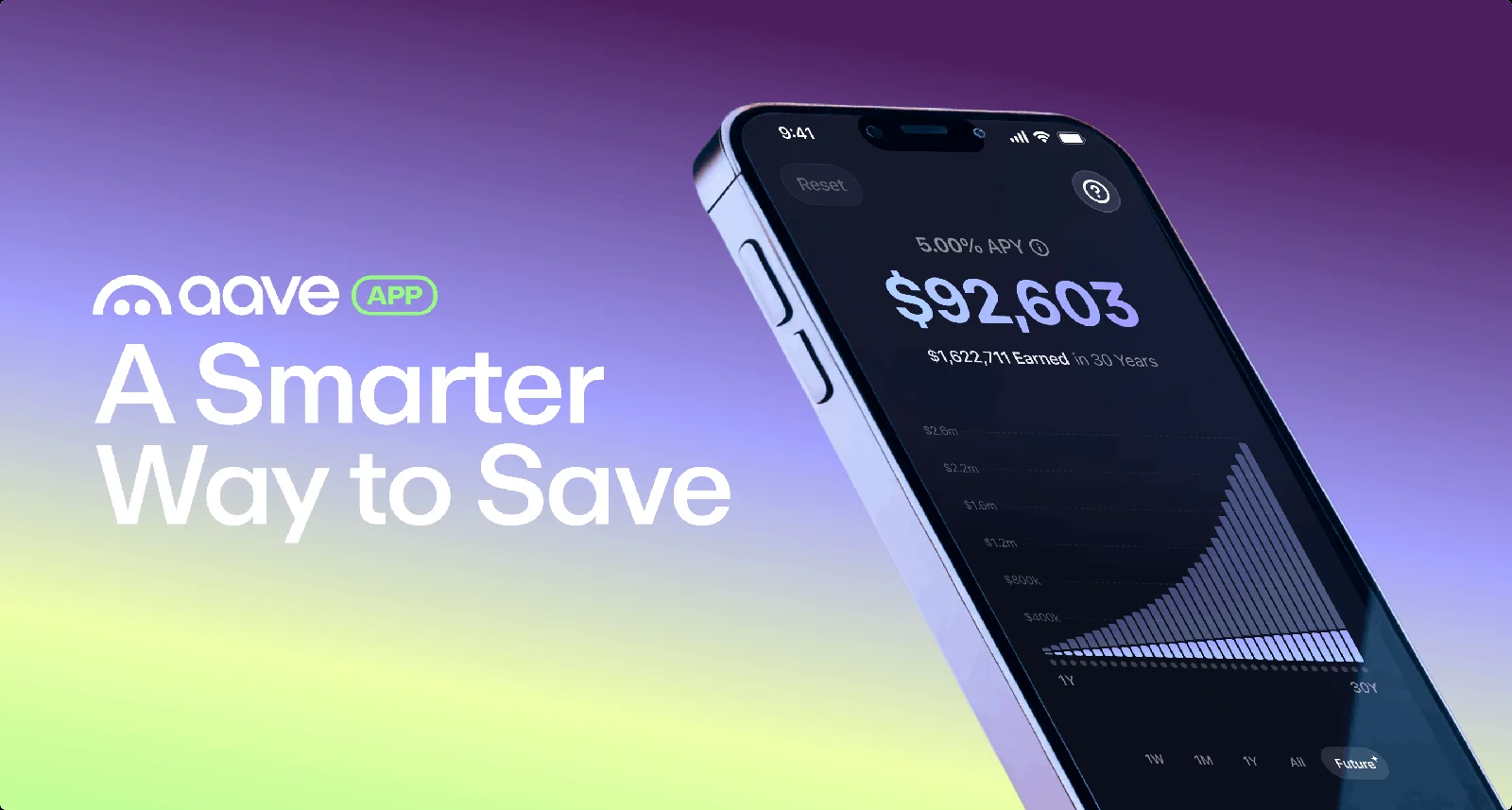
Aave Labs opened the Aave App waitlist on 17 November 2025. Its introduction described a consumer savings interface with earnings projections, recurring deposits called Auto Saver and bank, debit-card and stablecoin funding. The headline was up to 9% annual percentage yield, or APY, with boosts linked to actions such as identity verification, automatic deposits and invitations. Auto Saver carried a stated extra 0.5 percentage point. These were claims in the dated introduction, not a rate quote available to every reader today. The post also promoted balance protection of up to $1 million.
[1]Protection terms provide important later context
The Balance Protection Program terms, updated in July 2026, describe discretionary reimbursement, not customer insurance or a government deposit guarantee. They require both baseline eligibility and a qualifying tier. The published base tier lists a $100,000 cap, at least $1,000 maintained through the preceding 30 days, an accepted authenticator app without SMS authentication, and completed account recovery. The $1 million Gold tier is described as not yet available in that document.
The terms exclude market-value declines, stablecoin depegging and losses caused by compromised personal credentials, among other exclusions. A loss notification is due within seven days of awareness, with the completed claim due within 90 days of the event. These later conditions are essential context for the original headline. They do not rewrite the launch date or establish that a reader automatically qualifies for reimbursement.
[2]What an annual rate means in a simple example
Suppose a fictional account starts with $1,000 and earns a constant 5% APY for an entire year. With no additions or withdrawals, the end balance would be $1,050. APY already expresses the effect of compounding over the year, so adding another compounding bonus to that result would count the same effect twice. This example uses an invented rate to explain the unit; it does not estimate what an Aave App account will earn.
Now suppose the same person adds $100 at the end of each month. Their contributions alone total another $1,200. It would be wrong to call the entire increase above the original $1,000 “earnings.” Most of the larger balance came from the person’s own transfers, and each late contribution had less time to earn than the starting balance. A useful projection should make that distinction visible, particularly when a smooth upward chart combines contributions and returns.
A boost has to match the way someone saves
Consider two invented users with the same $2,000 starting amount. One wants to add money regularly after payday. The other has a single amount reserved for an expense in six weeks. They may see the same promotional headline, yet a recurring-deposit feature solves a much clearer practical problem for the first person. For the second, scheduling additional transfers may have little value because the money already has a near-term purpose.
Even a small percentage-point difference deserves translation into money. At an invented constant annual rate, an extra half percentage point on an unchanged $2,000 balance corresponds to roughly $10 over a year before compounding differences and other effects. Over a short holding period, the illustrative benefit is smaller. That arithmetic gives the feature a scale a reader can understand without treating the historical promotion as an available offer or assuming every balance receives the maximum advertised boost.
A projection and a protection promise answer different questions
A projection asks what a balance might become if its assumptions hold. Protection asks what happens after a specific adverse event and under a separate set of conditions. A high projected end balance cannot answer the second question. Conversely, a reimbursement cap does not establish a future interest rate. Combining the two numbers into one impression of a guaranteed savings outcome would erase the main distinction a reader needs.
The waitlist announcement is useful as a record of the product Aave intended to build: a savings experience with visible growth and recurring contributions. Evaluating an account requires the terms attached to that account at the time it is used. For a reader comparing the old introduction with the later protection document, the dates are part of the explanation. They show why a launch headline and a subsequent eligibility schedule should be read together rather than mistaken for the same promise.
Separate contributions from growth
Choose a step in this invented example.
| Case | What it means |
|---|---|
| Starting amount | $1,000 A fictional account begins with $1,000. |
| Monthly additions | $1,200 more Twelve $100 contributions add $1,200 of the person’s own money. |
| Before earnings | $2,200 contributed A balance above the starting $1,000 is not all investment return. Contributions must be separated. |
Illustrative example only. No live quote, account action or guaranteed outcome.
- Announced 17 November 2025.
- Initial product waitlist.
- Promoted rate was conditional.
Official sources & further reading
Independently written from the primary sources below. Checked on 26 September 2026.
- Aave App introduction ↗Announcement · 17 November 2025
- Aave App Balance Protection Program Terms ↗Documentation
Move up the Aave App waitlist
Code 7601C1 provides queue priority, not a cash bonus or higher APY.
Permanent code and partner link. Campaign dates and benefits are separate.
We may earn a commission, at no extra cost to you. Account and country conditions apply.