At a glance
- What changed
- Separate wallet service.
- Who it affects
- Readers comparing custody.
- When
- 22 September 2026
Bitvavo welcome offer and conditions ↓
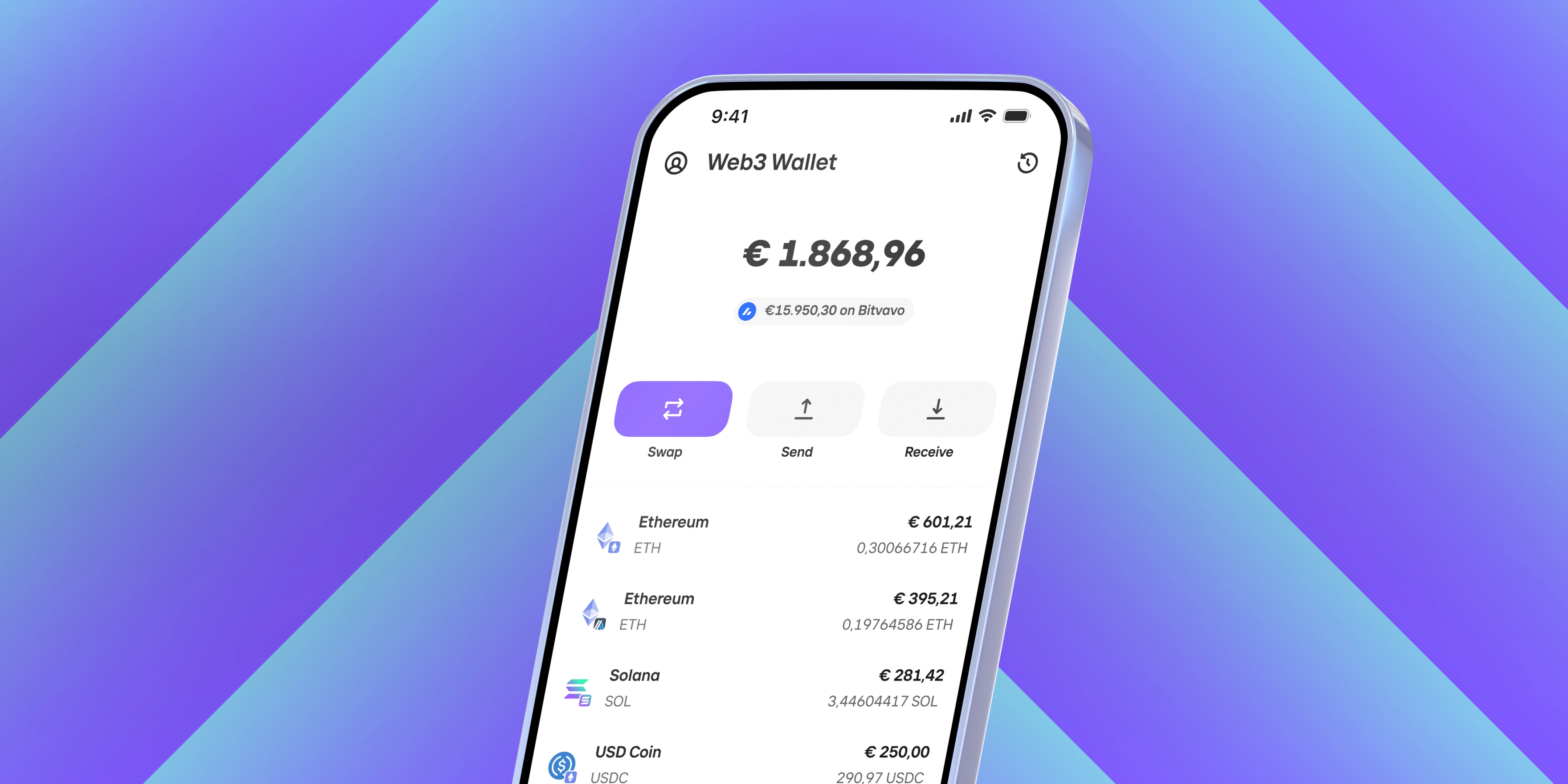
A self-custody wallet within the Bitvavo app
Bitvavo introduced its Web3 wallet on 22 September 2026, opening access to more than 15,000 assets beyond its exchange listings. Users control the private key. The provider is Vavo Web3 Limited, separate from Bitvavo B.V.; Bitvavo says the service is outside MiCA and regulated-service protections may not apply. Wallet assets are not reviewed or verified by Bitvavo.
[1]Where to begin and how to add funds
The launch instructions start in the app's profile: select Web3 wallet and confirm the password and two-factor authentication. Funding can come from an external wallet or through Receive, then Receive from Bitvavo. Supported-network swaps show applicable fees before confirmation. Bitvavo also says the wallet's private key can be exported.
[1]Why an exchange balance works differently
Bitvavo's hosted-wallet help explains that it cannot give customers the private keys for their individual exchange wallets. Those are wallets managed by the service. That older help page concerns the exchange account, so its statement should not be mistaken for a restriction on the separately announced self-custody wallet.
This distinction answers a practical question: which part of the app is holding the balance? An exchange withdrawal and an action signed through a personally controlled wallet can have different authorization processes. Knowing which service is being used is more informative than simply recognizing the Bitvavo logo.
[2]A private key controls transactions; an address identifies the account
Ethereum's account documentation explains the relationship in plain terms. An account controlled by a private key uses that key to sign transactions. The signature proves authorization; the public address identifies the account. The funds remain recorded on the blockchain, while the wallet application provides the interface used to interact with them. This is Ethereum background, not a claim that every supported network or Bitvavo recovery process works identically.
The difference matters when preserving access. A receiving address can help identify where assets belong, but it cannot replace the secret needed to authorize their movement. Exporting a private key is therefore about retaining control, not downloading a list of balances. The announcement does not provide a complete device-loss recovery procedure. Users should establish the official procedure for their installed wallet before assuming that resetting an app password restores every form of access.
[3]Check the receiving network when moving back to the exchange
Bitvavo's current exchange network guide says multiple deposit networks are supported only for particular assets. It specifically lists Ethereum mainnet, Base and Arbitrum for ETH, and directs users to the networks page for the actual supported route and whether deposits or withdrawals are active or under maintenance. This is guidance for the exchange side of a transfer; it is not the new Web3 wallet's complete network list.
The practical consequence is that an asset visible in the wallet is not automatically depositable into the exchange on the same network. The receiving service's instructions need to match the asset and route being sent. A familiar ticker alone does not settle that match. The wallet's broader asset menu should therefore be read as access to additional on-chain assets, rather than an expansion of every exchange deposit option.
[4]Understand the network charge alongside the swap quote
Ethereum's fee documentation defines gas as the computation needed to process an operation. On Ethereum mainnet, the fee is paid in ETH and depends on the gas used and its price. An executed transaction that runs out of gas can fail while still consuming fees for work performed. A more complex contract interaction can require more computation than a simple transfer.
That explains why the value being swapped and the cost of processing the action are separate quantities. It also explains why a failed attempt does not always imply that no fee was spent. These mechanics describe Ethereum; they do not specify Bitvavo's total wallet tariff or the fee asset on every supported chain. For the actual swap, the relevant figures are the input amount, expected output and disclosed charges shown together before approval.
[5]The change is control as well as convenience
The wallet addition brings an on-chain workflow closer to existing exchange users. Its most consequential difference is who authorizes the movement of the assets. Understanding that difference makes the setup, backup and transfer questions fit together: identify the service holding the balance, preserve the appropriate access method, and match the receiving network before treating a transfer as complete.
Compare an invented transfer record
Keep the route beside the amount.
| Case | What it means |
|---|---|
| Amount only | 100 units The number alone leaves the asset, network and receiving address unresolved. |
| Complete route | Match the destination In this invented record, note all three identifiers before comparing what arrived. |
Original reading exercise, not a live transfer check.
Official sources & further reading
Independently written from the primary sources below. Checked on 26 September 2026.
- Bitvavo Web3 wallet announcement ↗Announcement · 22 September 2026
- Bitvavo: private keys for hosted exchange wallets ↗Documentation
- Ethereum accounts and private-key authorization ↗Documentation
- Bitvavo: supported networks for deposits and withdrawals ↗Documentation
- Ethereum gas and transaction fees ↗Documentation
€10,000 fee-free for 7 days + €10 bonus
New users need verification and an eligible €10 deposit. Check the current terms before funding. EU-focused exchange (MiCA-licensed, Netherlands).
Permanent code and partner link. Campaign dates and benefits are separate.
We may earn a commission, at no extra cost to you. Account and country conditions apply.