At a glance
- What changed
- Cash-first financing.
- Who it affects
- US readers assessing borrowing.
- When
- 24 September 2026
Kraken discount code and conditions ↓
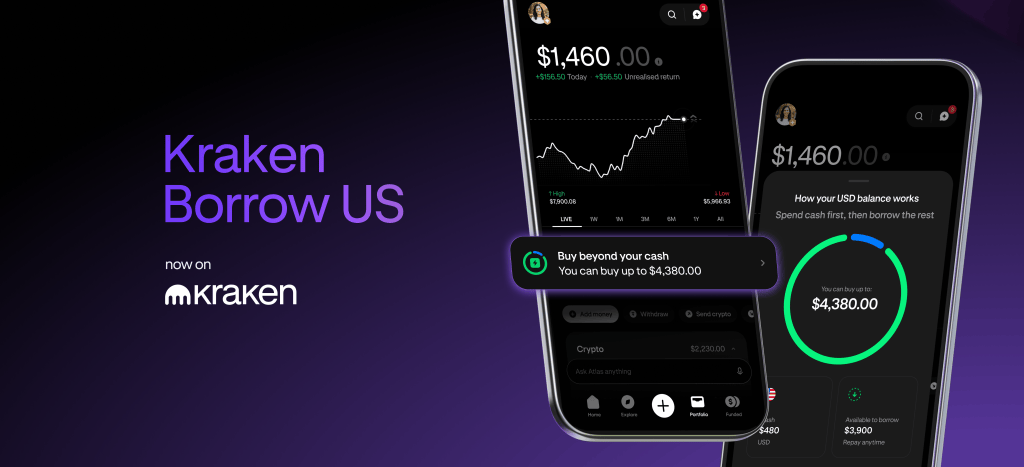
A purchase can now use cash and borrowing
Kraken introduced Borrow US on 24 September 2026. Eligible purchases use available dollars first and borrow only the excess. New York, Maine and customers exceeding $10 million in total investments are excluded. Trading and opening fees plus daily interest apply. Financed crypto cannot leave the platform before repayment. Borrow US is distinct from Kraken Borrow and Flexline.
[1]A debt can remain after collateral is sold
The risk statement linked by Kraken says positions can be liquidated, or forcibly sold, without a prior warning when required margin is not maintained. If sales and applied collateral fail to cover principal, interest and charges, the customer remains liable for the shortfall. It also describes affiliated counterparties and possible differences between liquidation prices and market references. These conditions mean a loss need not stop at the money initially committed.
[2]Read the purchase as two amounts
The first useful question is how much of a proposed purchase comes from money already available and how much creates a debt. A single buying-power figure can conceal that distinction if it is read as though it were a cash balance. Capacity to finance a purchase is not the same as owning the money needed to pay for it.
Imagine a customer with $500 of cash who intends to buy $300 of an asset. Ignoring all fees solely to isolate the funding split, the purchase fits within cash and leaves $200. Nothing in that arithmetic requires borrowing. Now change the intended purchase to $800 while keeping the original cash balance unchanged. The difference is $300, which must come from another funding source.
The selector below uses precisely those invented figures. It assumes sufficient approved capacity and excludes every cost. Its purpose is to make the financed amount visible, not to say whether the customer should take on the obligation.
Follow a price change through the whole position
Continue with a simplified $800 purchase funded by $500 of the customer’s money and $300 of debt. Assume no other assets or costs for this illustration. If the purchased asset falls 10%, its value becomes $720. Subtracting the unchanged $300 principal leaves $420 before interest and fees.
The asset fell 10%, but the customer’s starting $500 has become $420 in this deliberately simplified calculation, a 16% reduction. The difference arises because the debt did not shrink alongside the asset. This is an explanation of borrowed exposure, not a simulation of Kraken’s actual collateral or liquidation calculations.
If the asset rises 10% instead, its value becomes $880 and the same subtraction leaves $580 before costs. The effect works in both directions. Showing only the favorable case would hide the mechanism that also magnifies a loss. Neither case predicts a market move or determines the account’s borrowing health.
Costs belong beside the debt from the beginning
Suppose a fictional financing arrangement adds an opening charge of $2 and interest of $0.30 per day. After ten days, those invented amounts total $5. After thirty days, they total $11. These are not Kraken’s rates; they demonstrate why the intended holding period affects a comparison even when the purchase price is unchanged.
A person who expects to close a position quickly may nevertheless end up holding it longer. A useful personal calculation should therefore show several possible durations instead of assuming the shortest one will occur. The question is not just whether a trade might gain value, but how much gain would remain after the cost of maintaining it.
The same discipline applies to a loss. Adding financing costs to a negative price result gives a clearer picture than discussing the market movement and the loan as unrelated events. Both arose from the decision to hold the financed position.
Repayment changes the obligation, not the past price
Imagine the customer later pays $100 toward the simplified $300 principal. Ignoring accrued charges only for this example, the remaining principal becomes $200. That repayment reduces an obligation; it does not undo any market movement that occurred before it.
A completed record should therefore distinguish the original purchase, later price changes, charges and repayments. Those entries allow a reader to explain the outcome without confusing a rising account value with a smaller debt. An account can show more valuable assets while still carrying the same principal.
Borrow US adds financing to a familiar purchase flow, which makes that separation particularly useful. Before interpreting a larger buying-power number as an advantage, a reader needs to see the portion that creates debt and the conditions attached to keeping it open. The article explains that accounting relationship while leaving account approval, live prices and the actual financing quote to the product’s own records.
See the cash and borrowing split
Adjust a hypothetical cash balance and purchase size. The illustration assumes sufficient approved capacity.
Illustrative examples: $300 is covered by cash, leaving $200 before costs. The arithmetic introduces no borrowed amount. This is an illustration of the funding split, not an account quote. $500 cash plus $300 borrowing covers the $800 purchase before costs. Changing the purchase size creates debt even though the starting cash is identical. The example does not determine borrowing eligibility.
Purchase minus available cash, with borrowing floored at zero. Fees, interest, collateral requirements and liquidation are excluded. This is arithmetic, not an eligibility check or loan quote. [1]
Official sources & further reading
Independently written from the primary sources below. Checked on 26 September 2026.
- US launch announcement ↗Announcement · 24 September 2026
- Spot margin risk disclosure ↗Official risk statement linked by kraken
20% off trading fees
Enter j73wpf7w in the Invite Code field during signup.
Permanent code and partner link. Campaign dates and benefits are separate.
We may earn a commission, at no extra cost to you. Account and country conditions apply.