
BaseDiscount code
10% off eligible swap fees
Base referral code: 2ZTS468P. Sign up with this code to get 10% off eligible swap fees.
Affiliate link. We may earn a commission, at no extra cost to you.
At a glance
- What changed
- Base's own explanation of the security layers behind the network, from code review to withdrawal proofs.
- Who it affects
- Anyone holding funds on Base, including USDC users, and teams building apps on it.
- When
- Published on Base's official blog on 24 November 2026.
Add Exchange.news as a preferred source on Google
What Base published
Base, the Ethereum layer 2 network incubated by Coinbase, published a post on 24 November 2026 titled “How Base is secured in layers.” It opens by noting that security “is on a lot of people's minds right now” and says the network is built so that “if one ever falls short, another is there to catch it.”
The post walks through four layers: how code is reviewed, who can approve upgrades, how the network's state is proven on Ethereum, and how everything is monitored. It ends with advice for teams building on Base.
Code review and bug bounties
Every Base network upgrade is reviewed by Base's own security engineers and by outside auditors, and also goes through an internal AI-powered audit that probes the code for weaknesses. For major upgrades the code is opened to the public: a $250,000 audit competition ran before Azul, Base's first independent upgrade, and a second $250,000 competition is open now. Bug bounties pay up to $5M on Cantina for Base's smart contracts and up to $1M on HackerOne for infrastructure.
Base also says it keeps the system small. Denim, its fourth upgrade this year, went live on 5 November and replaced Flashblocks with native 200ms blocks, retiring the infrastructure behind them, while Cobalt in September moved registration for one of its two provers onchain.
No single key can change Base
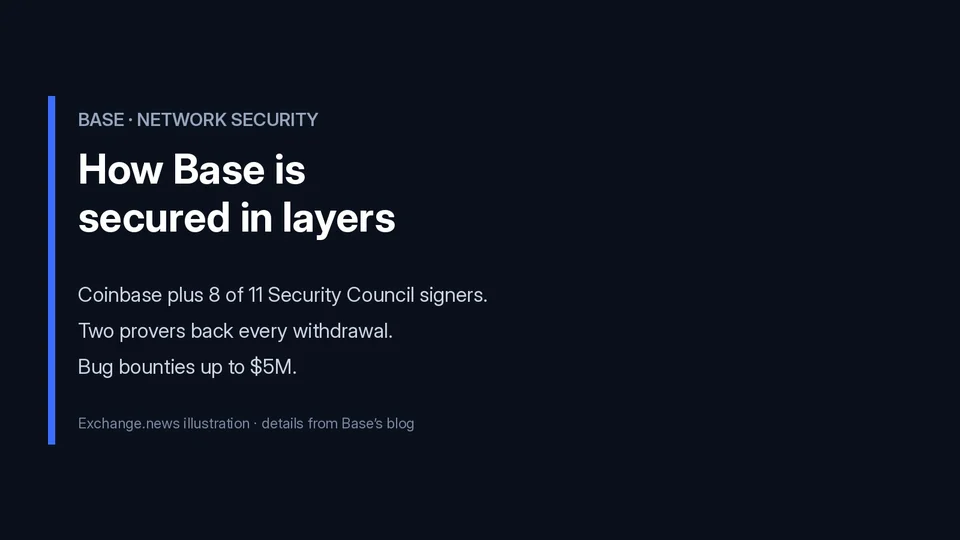
Upgrades to Base's core contracts need approval from both Coinbase and an independent Security Council of 11 members, at least 8 of whom must sign. “Coinbase can't upgrade Base on its own, and neither can the Council,” the post says. Every privileged action on the core contracts, including each Council signature, raises an alert for Base's security team.
Two provers behind every withdrawal
Base posts its transaction data to Ethereum, and its state must be proven there before any withdrawal to Ethereum is paid. It uses two independent provers: a trusted execution environment prover that re-runs blocks inside AWS Nitro Enclaves, and a zero-knowledge prover built on SP1, open-source software from Succinct. Each proposed state needs a proof from at least one of them, and if they disagree the ZK proof wins.
For users this sets withdrawal timing. A withdrawal backed by one proof completes after five days, leaving time for a challenge; when both proofs agree it can complete in about a day. Base adds that anyone can propose the network's state by depositing an ETH bond, so users do not depend on Base alone to get funds out. Automated monitors watch the bridge, proof system and core contracts around the clock.
What builders and users must secure
Base is clear about the limits of all this: it runs the protocol, teams secure their own contracts, keys and admin access, and users secure their wallets. “Most losses in crypto come from compromised keys and admin access, not flaws in the chain itself,” it writes. Its advice for builders is to use multisigs or MPC, set spending limits and keep hot wallet balances low, set alerts on admin functions and large transfers, audit before launch and after major changes, delegate EIP-7702 accounts only to audited contracts, and report bugs through Coinbase's HackerOne program.
Why it matters
The post does not announce a new feature, but it puts on record who can change Base and how fast funds can leave it, two questions that matter to anyone keeping USDC or other assets on the network. The practical lesson for ordinary users is the one Base stresses itself: the chain's safeguards do not protect a wallet whose recovery phrase or keys leak, so keep them offline and private.
Dates to know
As announced by the provider. A listed date does not confirm current availability or eligibility.
- Denim upgrade goes live with native 200ms blocksDate passed
- Base publishes how the network is secured in layersDate passed
BaseDiscount code
10% off eligible swap fees
Base referral code: 2ZTS468P. Sign up with this code to get 10% off eligible swap fees.
Affiliate link. We may earn a commission, at no extra cost to you.
Conditions
New wallets only; enter the code during onboarding. Same-chain swaps and regional eligibility rules apply.
The code and partner link have no expiry. Campaign dates, benefits and eligibility are separate and may change. Check the provider’s current terms before signing up.