From the archive. This story describes the announcement at its original publication date. Product availability, pricing and terms may have changed.
At a glance
- What changed
- Historical USDC rewards.
- Who it affects
- Readers comparing reward periods.
- When
- 20 November 2024
Base discount code and conditions ↓
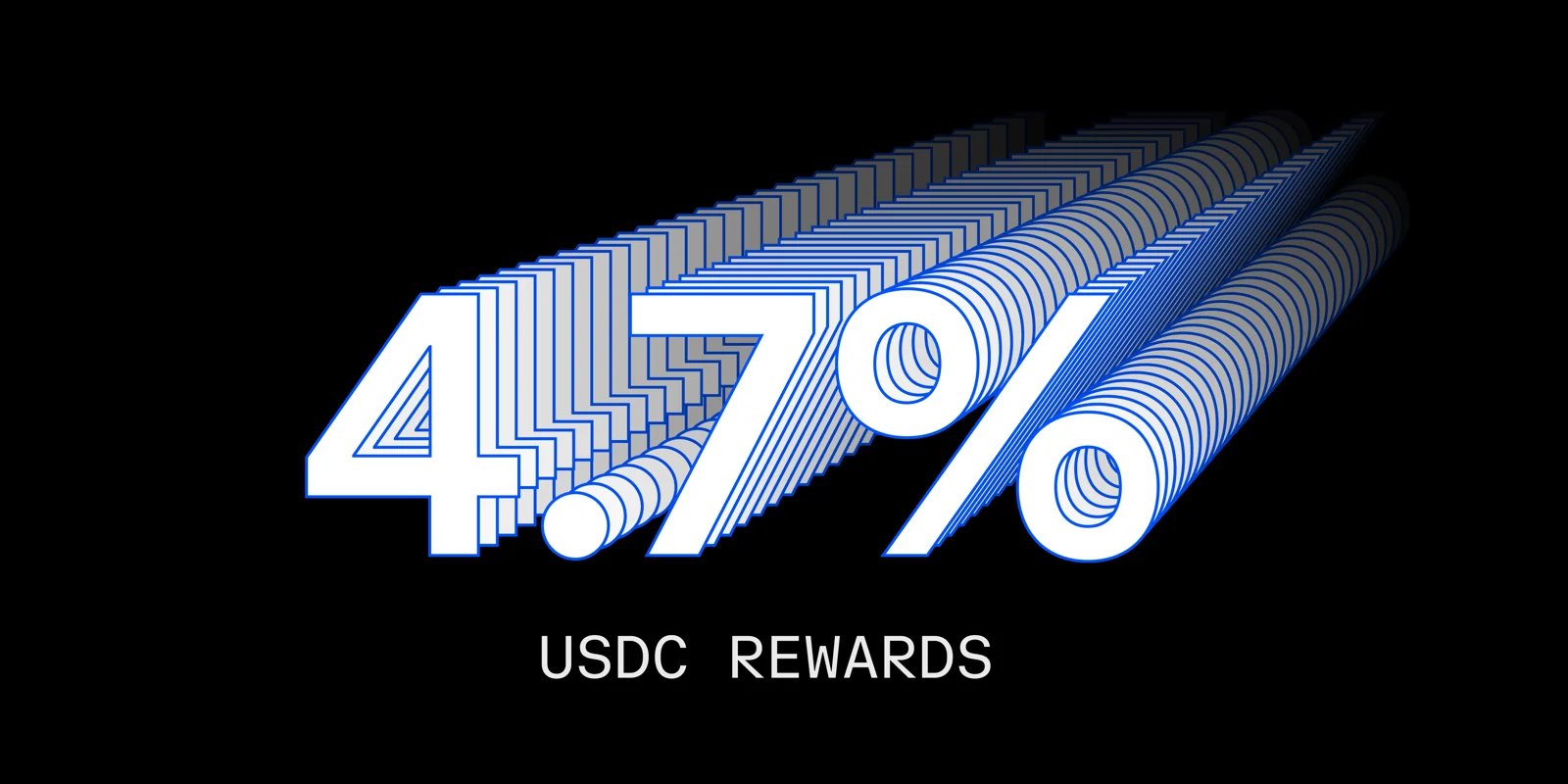
Coinbase Wallet added rewards for eligible USDC balances
Coinbase Wallet introduced USDC rewards on 20 November 2024, advertising a variable 4.7% annual percentage yield. APY expresses a compounded yearly rate, not a monthly payment. The launch described no holding lockup and monthly payments on Base. Eligible balances could sit on Base, Ethereum, Arbitrum, Avalanche C-Chain, Polygon or Optimism. The EU and Canada were excluded; US users needed a linked Coinbase account. These are historical launch terms, not a current rate quotation.
[1]A provider-funded reward, with separate enrollment
Coinbase's USDC help page identifies the arrangement as a loyalty programme funded by Coinbase. It says Coinbase has no right to use the USDC in the user's wallet. Eligible users activate rewards from the USDC asset page; simply seeing a USDC balance and being enrolled are therefore different states.
That document describes payment on Base within five business days of the following calendar month.
[2]A different current payout description
Another current Base rewards page describes daily accrual and weekly payouts. Because those official pages differ, this archive preserves the 2024 monthly launch terms rather than asserting a single current schedule for every wallet experience. The applicable in-app programme is the relevant place to resolve the present schedule.
[3]Why the network of payment matters
Imagine someone keeps a balance on Ethereum and checks only that network when looking for a reward. In a programme that pays on a different network, a missing entry in the first view would not, by itself, establish that no payment arrived. The useful comparison is between the enrolled balance, the reward period and the destination account shown by the programme.
This is an accounting distinction, not an instruction to move funds between networks. A person may decide that the balance is already in the right place for an upcoming purchase. Moving it solely to make two screens look alike could create an additional transaction without solving a genuine problem. The historical news matters because it separated the location of eligible holdings from the location of the reward payment.
An example that keeps the annual rate in perspective
Consider an invented balance of 1,000 USDC and assume, solely for this illustration, that a 4.7% effective annual yield remains unchanged for a full year. The resulting annual gain would be 47 USDC if all the assumptions behind that yield were satisfied. Dividing 47 by twelve gives about 3.92 USDC, but that is only a rough monthly average, not a promise about an individual payout.
A mathematically consistent monthly equivalent of the same annual yield is approximately 0.3835%. Applied to a constant 1,000-unit balance, that would be around 3.84 units for the first month. The difference arises because compounding includes earnings on earlier earnings. This calculation explains the meaning of an annual percentage; it is not Coinbase's payout formula and should not be used to dispute an account statement.
Now suppose the reader spends half the balance during the period. The original full-balance example no longer describes that person's situation. A useful personal record would show when the balance changed and which period each payment covers. It would not assume that an annual headline can simply be multiplied by the largest balance briefly visible in the wallet.
What this historical launch establishes
The product change gave eligible wallet users another reason to keep a usable stablecoin balance in the same place they paid from. Its practical appeal was the combination of access and a conditional reward, rather than a commitment to keep money untouched for a stated term. Someone evaluating that arrangement should distinguish three quantities: units held, rewards received and the cash value obtainable when needed.
Those quantities can be reviewed without confusing an old announcement with today's programme. The dated rate explains what Coinbase launched in November 2024. Enrollment and regional conditions explain who could participate then. A current screen and the terms attached to it explain a present account. Keeping those layers separate makes the archive useful even when the brand, payout schedule or reward percentage changes later.
Dates to know
As announced by the provider. A listed date does not confirm current availability or eligibility.
- Original USDC rewards launchDate passed[1]
Put an annual percentage in perspective
An original hypothetical exercise. Select a case.
| Case | What it means |
|---|---|
| Full-year illustration | 47 units At an assumed unchanged 4.7% effective annual yield, 1,000 units would gain 47 over a year. |
| Rough monthly average | About 3.92 units 47 divided by twelve is a rough average, not the programme’s payout formula. |
Illustration only; it does not check an account or predict a result.
Official sources & further reading
Independently written from the primary sources below. Checked on 26 September 2026.
- Onchain rewards for everyone: Earn 4.7% APY in USDC rewards on Coinbase Wallet ↗Announcement · 20 November 2024
- USDC on the Base app ↗Documentation
- Rewards on Base ↗Documentation
10% off eligible swap fees
New wallets only; enter the code during onboarding. Same-chain swaps and regional eligibility rules apply.
Permanent code and partner link. Campaign dates and benefits are separate.
We may earn a commission, at no extra cost to you. Account and country conditions apply.