At a glance
- What changed
- Fixed-term rewards with weekly compounding.
- Who it affects
- Account eligibility varies.
- When
- Launched 3 September 2026.
Kraken discount code and conditions ↓
What Kraken announced
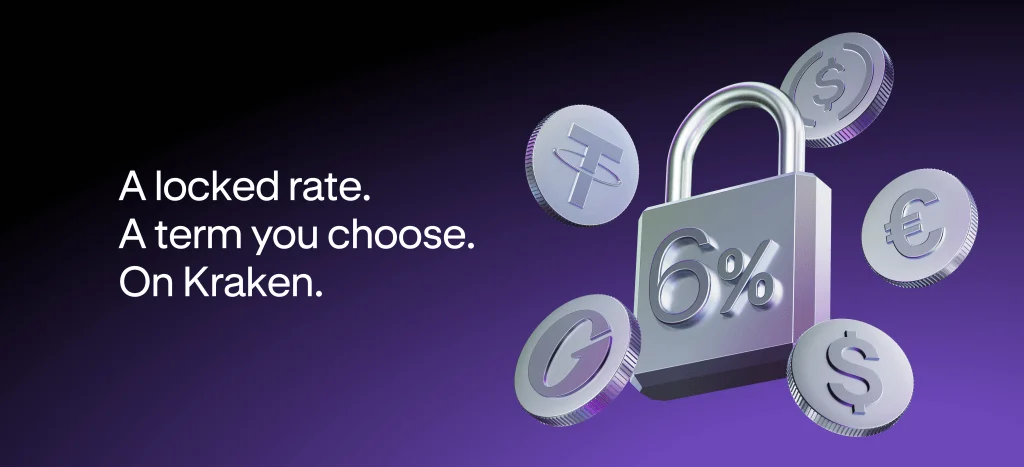
Kraken announced Fixed Rate Rewards on 3 September 2026 for eligible cash and stablecoin balances. The launch advertised annual percentage yields of up to 6%, with terms of three, six, twelve or eighteen months. An annual percentage yield, or APY, includes the effect of compounding. Supported balances in the announcement included USD, EUR, USDT, USDC and USDG. Rewards compound weekly within the allocation. The advertised maximum was a launch figure, rather than a rate promised to every account.
[1]What committing the funds means
Kraken’s current Opt-In Rewards guide says a fixed allocation stays locked until maturity; support cannot unlock it early. This is a contractual rewards product, distinct from blockchain staking and an insured bank deposit. Assets used by Kraken under the program cease to be held in custody for the client. The guide also describes extending an existing allocation: its amount stays unchanged, but its term, rate and release date are replaced immediately. The new term must exceed the time remaining on the old one.
Geographical documentation needs particular care. The launch described access for accredited US investors, while the general support guide excludes the US. Those statements have different scopes. An individual account’s applicable offer and agreement must establish access; this article does not resolve that discrepancy by assuming a universal US rollout.
[2]An annual rate is not the return for every term
Consider an invented example with 2,000 units committed for exactly half a year at an illustrative 4% APY. If the advertised annual yield applied consistently under the assumed calculation, the half-year growth factor would be the square root of 1.04. That produces approximately 39.61 units of rewards, before any product-specific rounding or other adjustments. It does not produce 80 units, because 80 is the growth over a full year at that annual yield.
This calculation is deliberately a teaching example, not a Kraken quote or a reproduction of its accrual engine. Its purpose is to expose a common comparison error. A reader considering different terms needs both the annualized rate and the time committed. A twelve-month offer with a higher annual rate also occupies the money for twice as long as a six-month offer. Comparing the percentages alone hides that difference.
Now suppose the same person expects to pay a 1,500-unit invoice four months from today. Even an attractive six-month illustrative allocation would place the invoice date before the planned return of the funds. Changing the hypothetical rate from 4% to 5% would increase expected rewards, but it would not fix that calendar conflict. The useful comparison starts with the payment date, then asks which money can remain committed beyond it.
Renewal is a second commitment
Kraken’s launch allows automatic renewal to be switched on or off during a term. Renewal uses the rate then available; switching it off returns funds at maturity.
[1]Two choices at the end of the example
Continue the fictional six-month example. At the end, the person may still want to earn rewards, but the situation could have changed: an upcoming expense might now require access within eight weeks. Repeating the same six-month choice simply because the previous allocation worked would ignore that new deadline. The sensible comparison is between the next commitment and the next use of the money, rather than between this month’s headline and last month’s headline.
A rate change creates a separate question. Imagine that the next term offers an illustrative 3% instead of the earlier 4%. A successful first term does not make the later rate 4%, and a new 5% illustration would not retroactively increase what the completed term earned. Each period has its own starting balance, duration and assumed yield. Drawing two boxes on a calendar makes that distinction more obvious than looking at one continuously rising balance.
The practical appeal of this release is therefore predictable terms for a defined period. Evaluating it well means understanding exactly which period the prediction covers. The worked figures above explain the arithmetic; the actual account confirmation supplies the available asset, applicable agreement, release date and offered rate.
Translate an invented annual rate
Choose a step in this invented example.
| Case | What it means |
|---|---|
| One year | Simple approximation $1,000 at an invented 4% annual simple rate would generate $40 over one year. |
| Half a year | Shorter period The same simplified calculation over half a year gives $20. |
| Three months | Shorter again A quarter year gives $10. This exercise omits compounding and is not a Kraken quote. |
Illustrative example only. No live quote, account action or guaranteed outcome.
- Four terms.
- Weekly compounding.
- Launch maximum: 6% APY.
Official sources & further reading
Independently written from the primary sources below. Checked on 26 September 2026.
- Kraken fixed rewards announcement ↗Announcement · 3 September 2026
- Overview of Opt-In Rewards on Kraken ↗Documentation
20% off trading fees
Enter j73wpf7w in the Invite Code field during signup.
Permanent code and partner link. Campaign dates and benefits are separate.
We may earn a commission, at no extra cost to you. Account and country conditions apply.