From the archive. This story describes the announcement at its original publication date. Product availability, pricing and terms may have changed.

OKXDiscount code
20% off eligible trading fees
OKX referral code: TRADEOFF20. Sign up with this code to get 20% off eligible trading fees.
Affiliate link. We may earn a commission, at no extra cost to you.
At a glance
- What changed
- Standalone wallet app.
- Who it affects
- Existing wallet users.
- When
- 16 April 2025
Add Exchange.news as a preferred source on Google
OKX separated its wallet into a dedicated app
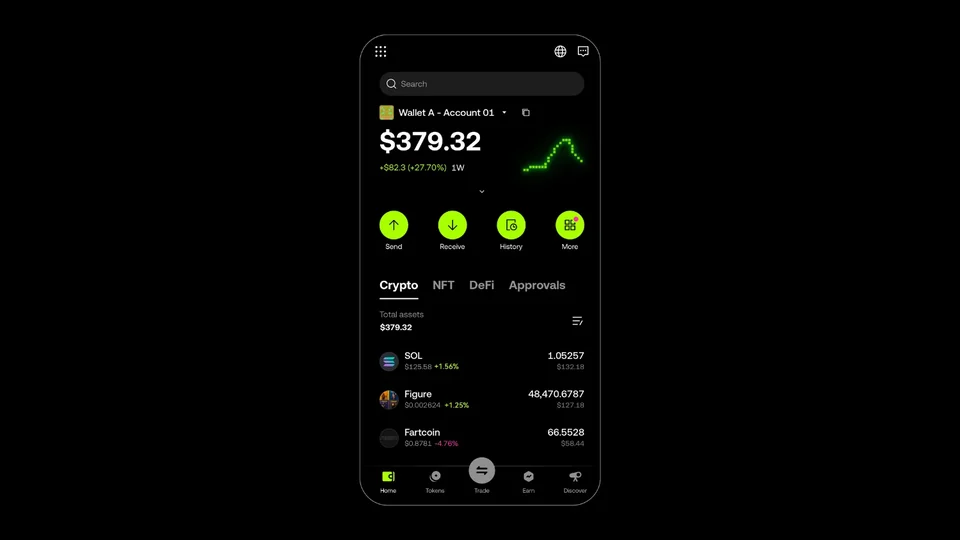
OKX announced a standalone Wallet app for iOS and Android on 16 April 2025. Existing users could import their wallet into the new application as wallet mode in the main OKX app was phased out. The announcement said existing balances were unaffected because users already controlled their own wallet credentials.
The original release also stated that Web3 services were temporarily unavailable in the EEA and that the global DEX aggregator was paused. Those were conditions at publication. They should not be read as a current service-status notice or as proof that every feature launched everywhere on the same day.
Importing is an access operation
OKX's wallet guide explains that an existing wallet can be imported using a seed phrase or private key. A seed phrase is the secret sequence used to restore control of a compatible wallet. The guide says OKX does not store that secret and cannot recover it for a user who loses it.
The same guide distinguishes importing from creating a new wallet and warns that uninstalling the extension deletes local wallet data. It recommends confirming a backup before reinstalling. These current instructions, checked in September 2026, explain the access mechanics relevant to the earlier app transition. They are not an invitation to disclose a secret to support staff or to this website.
Why a new app does not require a new destination
An app is an interface for inspecting balances and authorizing actions. A wallet address identifies the account involved in those actions. Confusing the interface with the account can lead someone to assume that installing a new app requires sending assets to a new address.
Consider a hypothetical user who has one wallet address and installs a compatible second interface. If the second interface accesses the same account, the user is looking at the same underlying activity through a different window. The installation itself is not a payment. By contrast, creating a new wallet produces a different account, and moving funds to it is a separate transaction. The distinction should be understood before deciding which setup path to choose.
An illustrative migration with two possible outcomes
Imagine Elena keeps a personal record of the last four characters of an address, its network and two recent transactions. Those public details are not her recovery secret. After setting up the new official app, she compares the displayed account with that record. If the address and known history match, she has useful evidence that she is viewing the intended account.
If the new app instead shows an empty account with a different address, there are several possible explanations. She may have created a new wallet, selected another account, or chosen a different network view. Sending money immediately would obscure that original question by adding another transaction. The clearer next step is to establish which account the interface is displaying.
In this example, no one needs to receive Elena's seed phrase to compare the public address and transaction history. The secret belongs only in the legitimate local recovery flow she has deliberately chosen. An unexpected message offering to “complete the migration” should not become the source of that flow. The purpose of the comparison is to verify access, not to turn an app change into an unsolicited transfer.
The launch and the service catalogue are different timelines
A dedicated wallet app can be available while one of its connected services is paused or unavailable in a region. For a user, that means “I can open my wallet” and “I can perform this trade” may have different answers. A clear migration article should preserve both questions instead of treating the app as one indivisible switch.
The April announcement matters because it changed where existing users were expected to manage their wallets. Its practical sequence was therefore access first, familiar account second, intended service third. Someone reading the archive later should use it to understand that transition, while checking the current interface for today's available functions.
Separating those steps also makes support conversations more precise. A missing account view, a failed connection and an unavailable trading service are different problems with different evidence. A readable account of the launch should help the user name the problem they actually have, rather than imply that every difficulty means assets were moved or lost during the app change.
Dates to know
As announced by the provider. A listed date does not confirm current availability or eligibility.
- Standalone app launchDate passed
OKXDiscount code
20% off eligible trading fees
OKX referral code: TRADEOFF20. Sign up with this code to get 20% off eligible trading fees.
Affiliate link. We may earn a commission, at no extra cost to you.
Conditions
Offer eligibility varies by product and region. Do not assume it applies to EU stock perps, Pre-IPO products or card payments.
The code and partner link have no expiry. Campaign dates, benefits and eligibility are separate and may change. Check the provider’s current terms before signing up.