From the archive. This story describes the announcement at its original publication date. Product availability, pricing and terms may have changed.
At a glance
- What changed
- Fogo network support.
- Who it affects
- People exploring Fogo.
- When
- 14 January 2026
Backpack discount code and conditions ↓
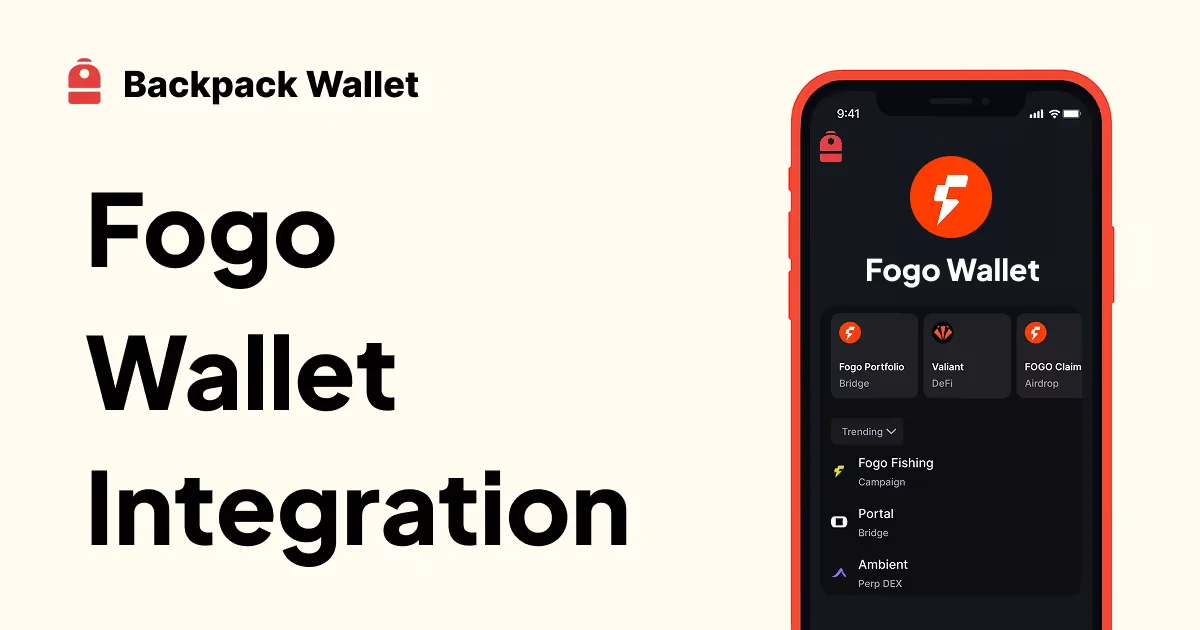
Backpack added Fogo as a separate network
Backpack announced Fogo mainnet support on 14 January 2026. Users could manage Fogo assets and connect to applications on that network from Backpack Wallet. Mainnet means the live network, rather than a testing environment.
The announcement explains how to add Fogo through the wallet selector and choose whether to create a wallet or import an existing one. It describes Fogo as compatible with the Solana Virtual Machine, the software environment used to run Solana-style programs. Compatibility makes tools and development approaches more familiar; it does not mean Fogo balances are the same balances a user holds on Solana.
[1]The network also has an application-session model
Fogo's own documentation describes Sessions, a mechanism that lets an application act within permissions the user grants. A session can specify permitted programs, token limits and an expiry. Paymasters can cover network charges, avoiding a separate fee payment for each supported interaction.
That documentation distinguishes limited and unlimited sessions. It is useful context for someone exploring the network through a newly supported wallet, but Backpack's integration announcement does not promise that every Fogo application implements the same session settings. A wallet connection, a permission to act and a payment of network costs should therefore be read as separate parts of an application flow.
[2]Adding a network is not moving an existing balance
Imagine a person who has used Backpack only for Solana. After adding another network to the interface, the familiar layout can make the change feel like opening a new tab in the same account. The better analogy is adding another ledger to the view: the user now has a way to inspect and authorize activity in a different environment.
An existing asset does not move merely because another network appears in a selector. The distinction matters when a person is waiting for a payment. The network selected by the sender and the network expected by the recipient need to describe the same route. Otherwise, looking repeatedly at the new account view will not explain what happened to a transfer initiated somewhere else.
An illustrative application allowance
Consider a hypothetical Fogo application that asks a user to authorize up to 40 units of an imaginary token for twenty minutes. The numbers and application are invented. That request has three meaningful boundaries: what can act, how much it can use and how long the permission lasts. A user who understands those boundaries can decide whether they match the intended activity.
Suppose the person plans to try four actions costing five units each. The planned use totals twenty units, leaving twenty units of unused allowance in the example. The allowance is permission, not a forecast of what will be spent. It also does not mean the user has earned the unused amount as a reward.
Now suppose the same task is presented with an unlimited allowance and no clearly understood end to the session. The visual convenience may be similar, but the user's decision is different. The narrower and broader requests should not be treated as interchangeable merely because both reduce repeated confirmation prompts. This is an explanation of permission scope, not a claim about the settings of any particular Fogo application.
How the integration changes the user's sequence
Before the integration, a Backpack user interested in the network had to consider whether the existing wallet could display and authorize the intended activity. The announcement addressed that access question. The next question belongs to the application: what exactly will the connection permit, and which asset will the action use?
A useful first journey is deliberately specific. A user identifies one application, establishes the correct network view, and reads the proposed action before approving it. After completion, the user compares the expected asset movement with the recorded result. That sequence makes it easier to locate a misunderstanding than attempting several unrelated actions simply because a new network is available.
The news therefore has a clear practical scope: Fogo became accessible from Backpack's wallet interface. The network's technical compatibility can make development and navigation more familiar, while its separate balances and application permissions still need their own explanation. The integration expands a user's available tools; it does not, by itself, establish the quality, price or suitability of every application reachable through them.
Read a fictional allowance
An original hypothetical exercise. Select a case.
- Planned actions
20 units needed
Four invented actions costing five units each require twenty units.
- Granted allowance
40 units permitted
A forty-unit permission is twice that plan. Permission is not a prediction of spending.
Illustration only; it does not check an account or predict a result.
Official sources & further reading
Independently written from the primary sources below. Checked on 26 September 2026.
- Backpack Wallet Now Supports Fogo Mainnet ↗Announcement · 14 January 2026
- Fogo Sessions ↗Documentation
5% off trading fees
Apply the code during account creation.
Permanent code and partner link. Campaign dates and benefits are separate.
We may earn a commission, at no extra cost to you. Account and country conditions apply.