
BaseDiscount code
10% off eligible swap fees
Base referral code: 2ZTS468P. Sign up with this code to get 10% off eligible swap fees.
Affiliate link. We may earn a commission, at no extra cost to you.
At a glance
- What changed
- A Coinbase statement that client assets are safe despite rumours of an AI-driven cryptography break, plus a summary of its post-quantum custody work.
- Who it affects
- Coinbase customers and anyone holding crypto who has seen the AI factoring rumours.
- When
- Published on the Coinbase blog on 28 November 2026 (dated 08:00 Pacific time, 17:00 in Amsterdam).
Add Exchange.news as a preferred source on Google
What Coinbase said
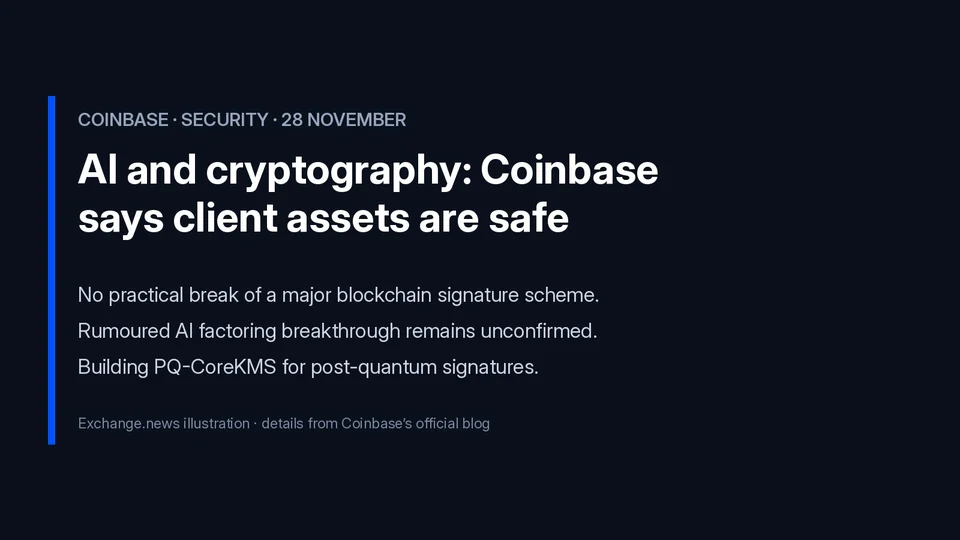
Coinbase published a post on its official blog on 28 November 2026 titled “AI and cryptography: What we know and how we protect client assets”. Its opening line is direct: client assets at Coinbase are safe. The company says its cryptography team, led by Yehuda Lindell, continuously assesses the algorithms it relies on, and that it does not currently believe any AI breakthrough poses an immediate and practical threat to the cryptography modern systems use today.
The post responds to a week of rumours that AI labs have found a polynomial-time algorithm for factoring large numbers. Coinbase says public clarifications have fallen well short of confirming such a result, that the expected research has been described as no imminent danger to deployed systems, and that it has seen no specific, actionable information behind the broader claims.
Real progress, but no practical break
Coinbase does not dismiss the research. It notes that new work has lowered estimates of the resources a future quantum computer would need to attack some current cryptography, and that AI-assisted research found weaknesses in a candidate post-quantum signature design before it was deployed. It also says researchers using AI have published a mild improvement to factoring that affects RSA, which blockchains do not use.
The key line for holders: as of 28 November, no one has publicly demonstrated a practical break of any major blockchain’s signature scheme. Coinbase adds two caveats. Keeping public keys out of view, where a network’s address design allows it, can reduce exposure to some attacks but is no substitute for upgrading signatures. And while Coinbase can upgrade its own systems on its own schedule, each network decides which signatures it accepts.
The custody work behind it
Coinbase says it had $377 billion in assets on its platform at the end of Q3 2026 and holds about 12% of all bitcoin, with its qualified custodian, Coinbase Custody Trust Company, regulated by the New York State Department of Financial Services. This year it set up an independent quantum advisory board in January, published the board’s first assessment in April, announced PQ-CoreKMS, a custody key-management system built to support different post-quantum signature schemes, in July, and published proposals for Bitcoin’s transition in October.
The company says the same remedy applies whether a weakness comes from quantum computers or a mathematical advance found by people or AI: moving to new signature schemes and being able to switch quickly. It says it is preparing to support post-quantum address types as networks adopt them, and that if it identifies a credible threat to client assets it will say so publicly and promptly, including what customers need to do.
Our take
This is a reassurance post rather than a product change, and nothing in it asks customers to act. Its most useful point is the distinction it draws: a better attack on RSA is not a break of the signature schemes blockchains use. Treat any message urging you to move funds because of an AI or quantum break as a likely scam; Coinbase says it would announce a real threat publicly.
BaseDiscount code
10% off eligible swap fees
Base referral code: 2ZTS468P. Sign up with this code to get 10% off eligible swap fees.
Affiliate link. We may earn a commission, at no extra cost to you.
Conditions
New wallets only; enter the code during onboarding. Same-chain swaps and regional eligibility rules apply.
The code and partner link have no expiry. Campaign dates, benefits and eligibility are separate and may change. Check the provider’s current terms before signing up.
 Ledger