From the archive. This story describes the announcement at its original publication date. Product availability, pricing and terms may have changed.
At a glance
- What changed
- Glider scanner integrated.
- Who it affects
- Degen plan at launch.
- When
- Supported EVM networks.
CoinStats welcome offer and conditions ↓
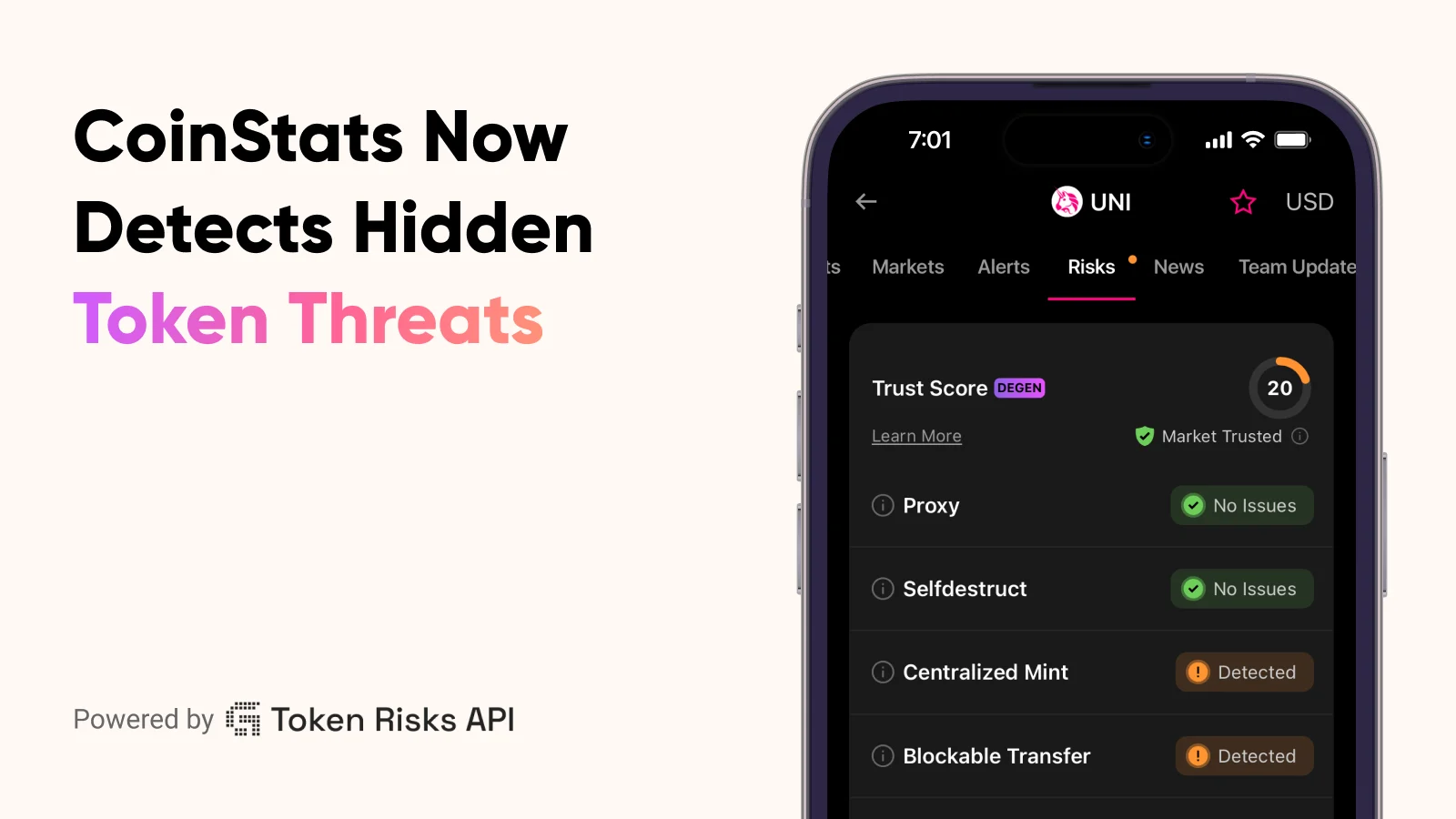
CoinStats integrates Glider contract-risk analysis
CoinStats introduced a token-risk scanner powered by Hexens’ Glider technology. The announcement lists checks such as restricted transfers, minting controls, hidden fees and upgradeable contracts. At launch, access was offered to Degen users on web, iOS and Android for the supported EVM networks. These are analysis findings to investigate, not a guarantee that an unflagged token cannot cause a loss.
[1]Translate a finding into a practical question
Imagine a fictional token contract with a control that allows a privileged account to pause transfers. The useful question is what that permission permits, who controls it and under which circumstances it can be exercised. A label saying that the control exists does not, by itself, prove that it will be abused or that its operator has good intentions.
The same reasoning applies to a minting permission. A reader needs to understand whether supply can change and who can authorise the change. The economic significance depends on the actual design and use of the permission, not merely on whether a warning icon appears beside it.
These are explanatory examples of how to read contract-risk categories. They are not findings about a real token. The goal is to turn a technical label into a question that can be answered from the contract and the project’s official explanation, rather than replace one unexplained trust score with another.
A worked example of an unexpected transfer cost
Suppose an invented token applies a 4% deduction to a transfer of 100 units. Under that simplified assumption, the deduction is four units and the recipient receives 96. If a buyer expected the recipient to receive 100, the difference matters even though the transfer itself completed.
Now imagine a second hypothetical design in which the relevant deduction can change. A calculation using yesterday’s percentage would not necessarily describe tomorrow’s result. The useful research question becomes whether the rule is fixed, who can alter it and where the current value is visible. This example is not a claim that Glider reports every possible fee mechanism or predicts future parameter changes.
Writing down the expected movement of value is a practical way to investigate a warning. Identify what leaves the sender, what reaches the recipient and what permission could change either amount. That is more informative than deciding that a token is acceptable merely because a total risk score falls below a chosen number.
Record what was checked and when
A useful scan record includes the exact contract address, network and time of the result. Token names and symbols can be reused, so a search result with familiar branding is not enough to identify the contract under review. The person should be able to return to the same object later and compare findings.
Suppose a reader scans one address, then opens a trading screen showing another. The earlier scan cannot be assumed to describe the second contract. Similarly, a later change to a system should prompt a fresh review of the relevant facts rather than reliance on an old screenshot. These are suggested research controls, not evidence that CoinStats selected an incorrect contract.
If a finding is unclear, preserve its wording and follow the available technical explanation. A clear question to support or a project team names the permission or function at issue. “Is this safe?” is less likely to produce a useful answer than asking who can change a particular rule and how that authority is constrained.
Understand what the launch benchmark can tell you
The provider’s announcement discusses its own benchmark results. We have not reproduced that evaluation, so this article does not treat it as independent proof that every serious risk will be found or that false positives are impossible. A benchmark can only establish results for its stated cases and method.
Our reading is that the scanner’s value is helping a non-specialist notice questions they might otherwise miss. It should make the underlying permissions easier to investigate. It cannot remove the need to identify the asset, understand the relevant controls and decide whether the uncertainty is acceptable for the intended use.
A good outcome is a more precise research note: the contract checked, the finding observed, the supporting explanation and the unanswered question. That is a stronger basis for a decision than either dismissing every flag as harmless or interpreting the absence of a flag as a promise of future performance.
Dates to know
As announced by the provider. A listed date does not confirm current availability or eligibility.
- Glider integration launchDate passed[1]
What does the scanner flag?
Choose a workflow to see what the change means.
- Administrative permission
Inspect who controls it
A minting or upgrade permission requires context.
- No visible warning
Keep the scope in mind
The announcement does not guarantee detection of every risk.
Feature scope follows the dated announcement. [1]
- Contract-logic analysis.
- Permission and fee checks.
- No universal safety guarantee.
Official sources & further reading
Independently written from the primary sources below. Checked on 26 September 2026.
- Stop Getting Rugged: Meet Glider Token Risk ↗Announcement · 23 September 2025
Free Premium trial
No code needed. Check trial length, renewal price and eligibility before starting.
Permanent partner link. Campaign dates and benefits are separate.
We may earn a commission, at no extra cost to you. Account and country conditions apply.