At a glance
- What changed
- Fomo connection added.
- Who it affects
- CoinStats portfolio users.
- When
- Spot scope at launch.
CoinStats welcome offer and conditions ↓
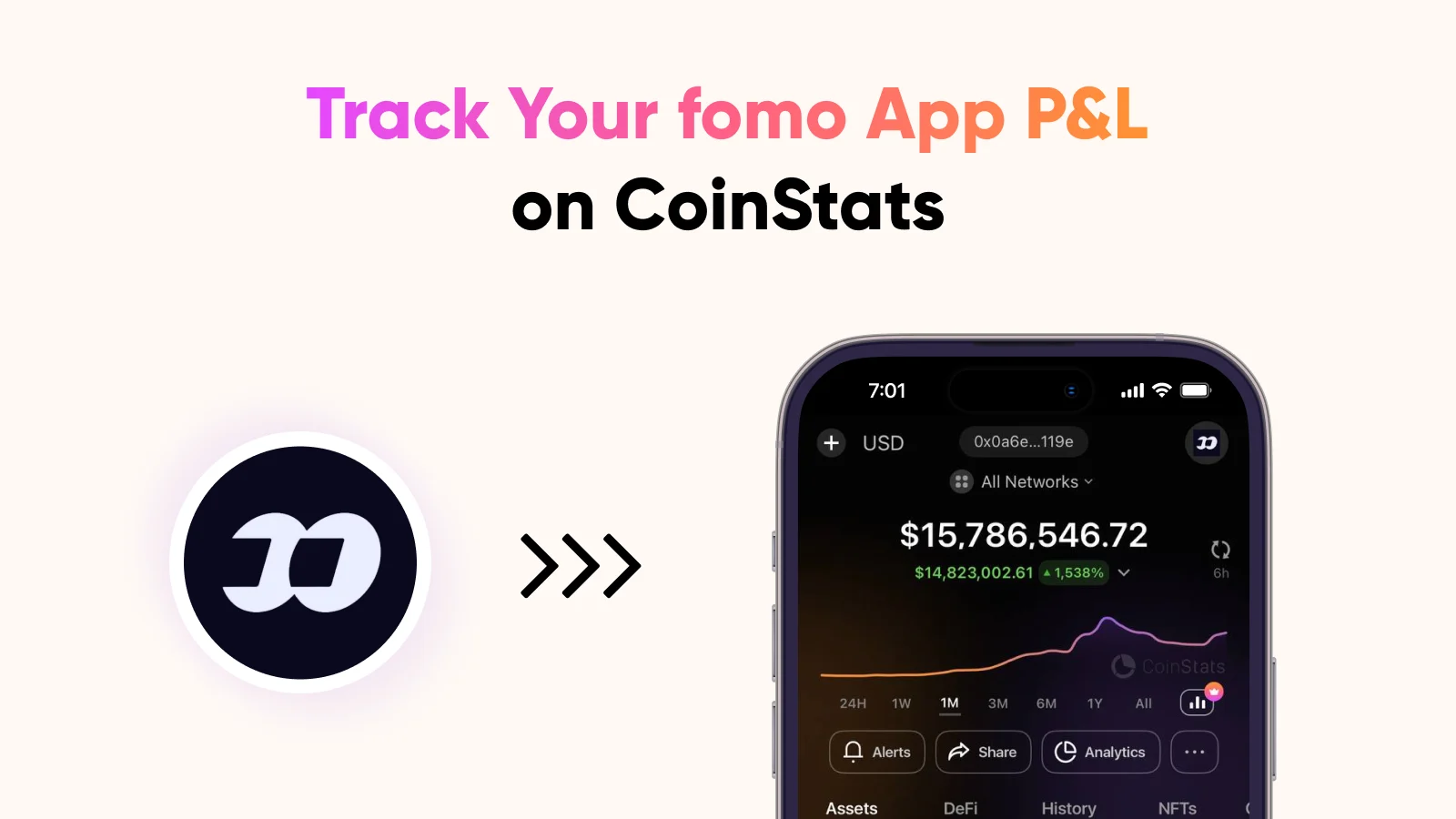
CoinStats connects Fomo portfolios by username
CoinStats introduced a Fomo connection that uses the person’s Fomo username rather than a pasted wallet address. The announcement covers spot holdings and transaction history, with portfolio, asset and trade-level profit-and-loss views. It explicitly excludes perpetual positions at launch. Readers should therefore judge the connection as a view of the supported activity, not assume it represents every position in the trading app.
[1]What the performance labels mean
CoinStats’ separate profit-and-loss explanation distinguishes realised results on sold assets from unrealised results on assets still held. It describes the combined figure as the sum of those two categories. Its interface also offers cost and average-price information, with transaction-level results available when history is filtered to a coin.
These definitions explain why two numbers can differ without either necessarily being an error. The value of the remaining holdings is not the same measure as proceeds from completed sales. The important question is which metric the reader is viewing and which transactions are included in it. A missing or incorrectly classified part of the history can make a comparison difficult to interpret, so the underlying activity is worth checking before relying on a summary.
[2]An illustrative trade review
Imagine a fictional sequence in which a trader spends 120 units of currency to buy four identical tokens. They later sell two for a total of 90, leaving two tokens. Ignoring all costs, the sold half originally cost 60, so its realised gain is 30. If the remaining two are now worth 50 in total, their unrealised result is a loss of 10. Together those results amount to a gain of 20.
These invented figures are not Fomo trading results and do not reproduce a live CoinStats calculation. They explain why a person can have profitable completed sales while the remaining position shows a loss. Looking only at the current holding would miss part of the story; looking only at the sale would miss the rest.
A practical review can trace one familiar trade sequence before examining a whole portfolio. Compare the entry, any partial exits and the remaining quantity. If those observations agree, the reader has a firmer basis for interpreting the broader chart than a green or red number alone provides.
Keep the connection’s scope visible
Suppose a person uses one app for both ordinary token holdings and leveraged trading. A tracker that includes only one category can still be useful, but it should not be mistaken for a complete financial picture. The person can keep a separate record of activity outside the connection’s stated scope and avoid adding unlike measures together without understanding them.
The same discipline helps when connecting several accounts. Before judging a total, write down which accounts it includes and which period is selected. A comparison between “this month’s supported trades” and “all money ever deposited” answers a different question from a comparison over one consistent period.
This is an editorial review method, not a claim that the integration misclassifies a particular account. Its aim is to make omissions visible before a person interprets the number as an assessment of their entire trading performance.
Turn social trading activity into an understandable record
Our reading is that the useful change is easier access to a structured record of activity that may have begun in a fast-moving social feed. A trade can be easy to enter and still deserve a slower review afterward. The review should identify what was bought, why it was bought, what changed and how the eventual result compares with the original reason.
For example, a trader could add a personal note at entry describing the intended holding period and the condition that would make them reconsider. Later, they can compare that note with the recorded transactions. The note is a suggested habit, not a CoinStats feature claimed by this release.
That approach makes the tracker useful for learning from decisions rather than merely celebrating a favourable number. Connecting a username is the convenient first step. Understanding the included history, the meaning of each metric and the unsupported activity is what turns the connection into a reliable personal review tool.
Which part of fomo do you track?
Choose a workflow to see what the change means.
| Case | What it means |
|---|---|
| Spot activity | Use the new connection Holdings and transactions are included in the announced scope. |
| Perpetual positions | Expect a coverage gap The launch explicitly excludes perpetual positions. |
Feature scope follows the dated announcement. [1]
- Username-based connection.
- Spot holdings and history.
- Perpetuals excluded at launch.
Official sources & further reading
Independently written from the primary sources below. Checked on 26 September 2026.
- CoinStats Integrates fomo App: See the P&L Behind Every Trade ↗Announcement · 15 September 2026
- CoinStats profit-and-loss explanation ↗Documentation
Free Premium trial
No code needed. Check trial length, renewal price and eligibility before starting.
Permanent partner link. Campaign dates and benefits are separate.
We may earn a commission, at no extra cost to you. Account and country conditions apply.