From the archive. This story describes the announcement at its original publication date. Product availability, pricing and terms may have changed.
At a glance
- What changed
- A $75 million Series B funds fomo.
- Who it affects
- Company milestone; user metrics are self-reported.
- When
- Announced 22 June 2026.
fomo discount code and conditions ↓
The funding announcement
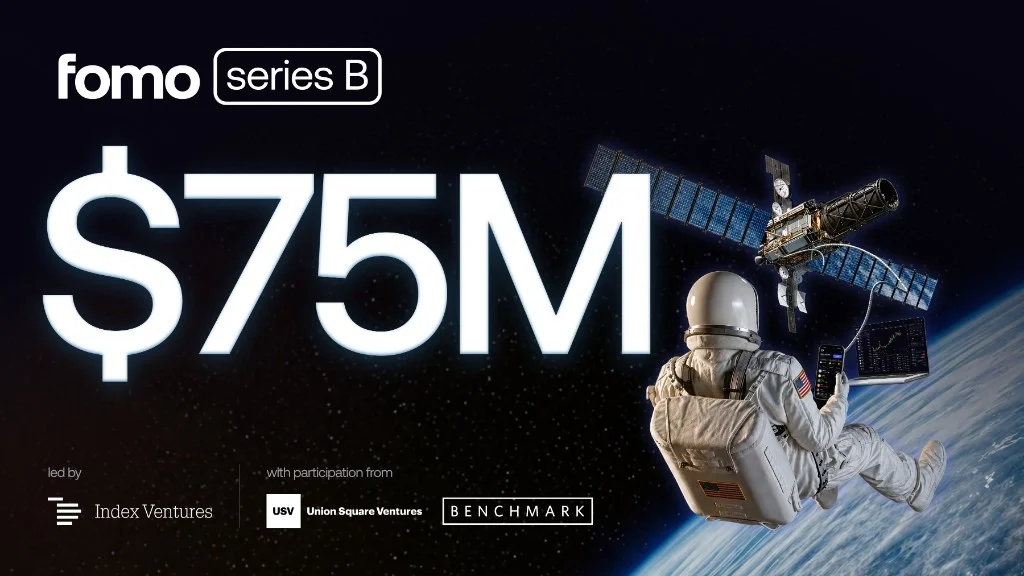
fomo announced a $75 million Series B on 22 June 2026, led by Index Ventures with participation from Union Square Ventures and existing investor Benchmark. The company reported more than 625,000 users, over $4 billion in trading volume and more than 110 million social interactions since launch. It also said over 68,000 first-time crypto buyers had purchased through Apple Pay, totaling $25 million. These are company-reported adoption figures, not independently audited measures of customer profitability.
[1]What the lead investor is backing
Index’s own announcement confirms the investment and explains its product thesis: make onchain trading accessible through a familiar consumer interface, with public trading activity supporting discovery and social interaction. It names the founders as Paul Erlanger, Se Yong Park and Prashan Dharmasena. Index describes Paul and Se’s shared experience at Deutsche Bank and dYdX and emphasizes their focus on interface design.
That investor account helps explain the financing’s purpose, but it is an interested participant’s assessment. Its praise for the team and the opportunity is not an independent evaluation of the assets available inside the app. The investment is in the business building the product; it does not turn a user’s purchase of an unrelated token into an investment alongside Index.
[2]User counts, volume and social activity measure different things
Consider a fictional app with one hundred registered users. If ten people each make twenty trades while ninety people make none, the app has two hundred trades, but only ten of those registered users traded in that period. A registration count and a trading-activity count can both be accurate while describing very different levels of participation.
Volume needs its own interpretation. Suppose one fictional user buys one thousand dollars of an asset and later sells the same position for one thousand. Counting the two transactions yields two thousand dollars of trading activity. The person has not necessarily added two thousand dollars of new money, and the unchanged sale value does not imply a trading gain. Repeated activity can increase volume without increasing the capital originally committed.
Social interactions add another dimension. Imagine those users post comments, like trades and revisit discussions. A rising activity count may show engagement with the interface, but it does not reveal how many participants understood a product or benefited financially. That would require other evidence. The point is to read each reported measure for what it actually counts, rather than combining several large numbers into one undefined claim of success.
What a social trading network can change for a reader
Imagine a newcomer discovering a token through a trader’s post. The useful part of a social interface is that the newcomer can ask what the person did, when they did it and what reasoning they supplied. Those questions are more concrete than treating follower count as an investment conclusion. A visible position can provide context without establishing that the same position is suitable at a later price.
For an invented price example, the original trader buys at one dollar and a reader discovers the post after the market reaches one dollar fifty. Even if both eventually sell at one dollar twenty, their outcomes differ. Before fees, the original entry gains twenty cents per unit while the later entry loses thirty cents. Observing the same eventual exit does not make the two trades economically equivalent.
This is a product-design challenge as much as an investing lesson. A helpful interface makes time, position size and current status visible enough that a reader can distinguish an old decision from a new opportunity. Making discovery easier is valuable, but shortening the path to a transaction does not remove those differences.
What to watch after a financing announcement
The funding provides resources for the company’s development plans; it is not itself a list of features already shipped. A reader assessing progress can look for subsequent concrete changes to supported services, access, usability or reporting. Those releases would supply their own dates and conditions rather than inheriting availability from the financing headline.
The clearest interpretation of this round is that named investors are financing fomo’s ambition to combine trading and social discovery at a larger scale. The reported metrics show the scale claimed at announcement. They do not establish future growth, the results of individual traders or a reason to buy any asset merely because it appears in a popular feed.
Distinguish activity from profit
Choose a step in this invented example.
| Case | What it means |
|---|---|
| One purchase | $100 traded An invented purchase adds $100 of one-way trading activity. |
| One sale | $100 traded again Selling the same position for $100 adds another $100 of activity. |
| Result | $200 volume, $0 gross gain The two trades total $200 of activity while the gross gain is zero before costs. |
Illustrative example only. No live quote, account action or guaranteed outcome.
- Series B: $75 million.
- Lead investor: Index Ventures.
- Metrics are self-reported.
Official sources & further reading
Independently written from the primary sources below. Checked on 26 September 2026.
- fomo Series B led by Index Ventures | fomo ↗Announcement · 22 June 2026
- Index Ventures on fomo’s Series B ↗Documentation · 22 June 2026
10% off all trading fees
Type findcodes inside the app during signup; it cannot be added later.
Permanent code and partner link. Campaign dates and benefits are separate.
We may earn a commission, at no extra cost to you. Account and country conditions apply.