
fomoDiscount code
10% off all trading fees
Type findcodes inside the app during signup; it cannot be added later.
Affiliate link. We may earn a commission, at no extra cost to you.
At a glance
- What changed
- fomo replaced third-party bridging with its own bridge and router for crosschain trades in the app.
- Who it affects
- fomo users who buy or sell tokens on one chain with funds held on another, for example Solana to Base.
- When
- Tested with a small share of users from about 15 October 2026; public rollout started on 22 October 2026.
fomo now moves crosschain trades itself
fomo announced on its official X account on 22 October 2026 that the public rollout of its own bridge has begun. The trading app says it switched a small percentage of users to the internal bridge a week earlier, and that crosschain transactions now land in under one second. A crosschain trade is one where the money sits on one blockchain and the token being bought lives on another, for example paying with funds on Solana for a token on Base. Until now, fomo relied on an outside bridging service for the step that moves value between the two chains.
The rollout is gradual, so not every account may be switched at the same moment. fomo did not publish a completion date, a list of supported routes beyond its charts, or any change to its trading fees, and it did not say the change depends on region. Nothing has to be enabled by the user; trades simply run through the new path once an account has it.
What the company says about speed and price
fomo pairs the bridge with its own router, the part that decides where and how an order gets filled. It says the router delivers execution 0.5% better on average and improves the worst 10% of trades by more than 2%. The company argues that speed matters most during volatile markets rather than quiet hours, and claims trades now execute up to 50% faster than any existing solution. It also says it processes more than ten times as many crosschain transactions as any other trading app, and that it now controls pricing, indexing, bridging and routing in one stack.
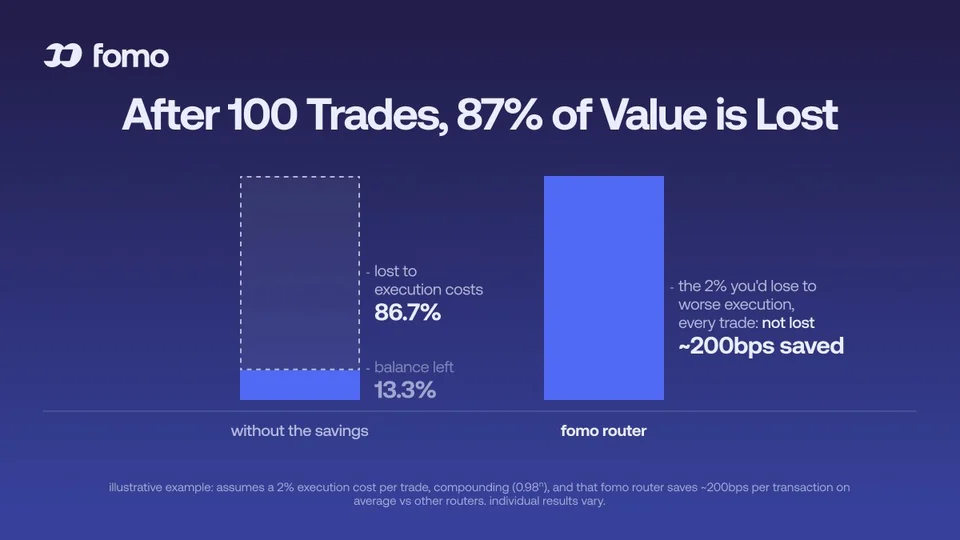
These are fomo’s own figures, and Exchange.news has not measured them. The company’s latency chart, which cites a public Dune dashboard, shows a median of 0.25 seconds on the Solana to Robinhood route on 21 October for its own bridge, compared with 0.34 seconds for pump.fun’s bridge and slower times for both apps when they used the Relay service. Another graphic in the thread works through a hypothetical case with a 2% execution cost per trade; that is an illustration, not the 0.5% average fomo reports, so it should not be read as the typical saving.
What changes for someone trading on fomo
For a user, the visible difference is the wait between pressing buy and seeing the position. With funds on Solana and a token on another chain, the order no longer depends on an outside bridge to settle, so a fast-moving token has less time to drift between the quote and the fill. Better routing also matters on small trades, where a fraction of a percent per order adds up over many trades.
It is still worth checking the quoted amount, the fee line and the price impact on each order before confirming, especially during sharp moves. A faster bridge reduces the delay but does not remove slippage, and the improvements fomo describes are averages across its own traffic rather than a guarantee for any single trade.
fomoDiscount code
10% off all trading fees
Type findcodes inside the app during signup; it cannot be added later.
Affiliate link. We may earn a commission, at no extra cost to you.
Conditions
The code and partner link have no expiry. Campaign dates, benefits and eligibility are separate and may change. Check the provider’s current terms before signing up.