From the archive. This story describes the announcement at its original publication date. Product availability, pricing and terms may have changed.
At a glance
- What changed
- Original European card.
- Who it affects
- Readers of the archive.
- When
- 25 November 2025
Krak discount code and conditions ↓
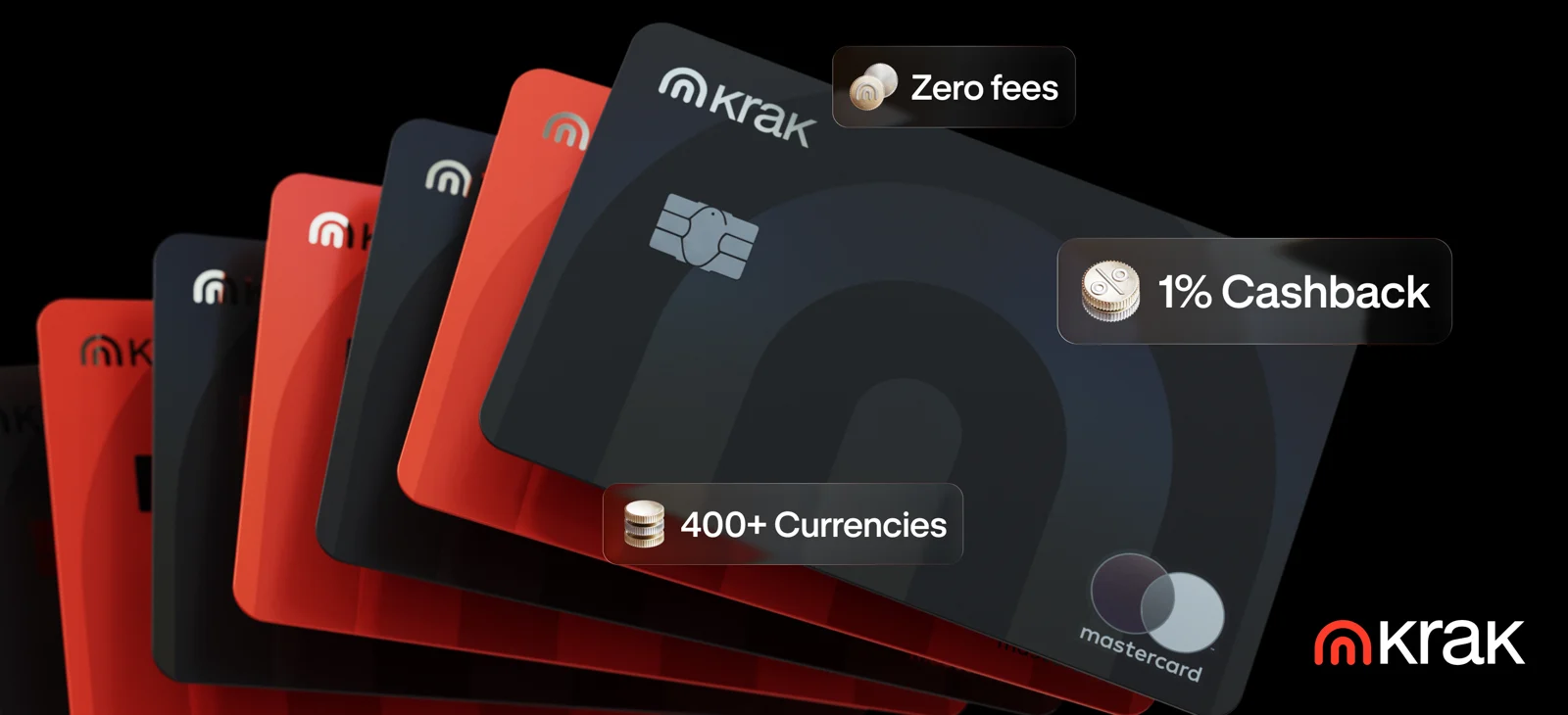
Krak's first European card linked everyday purchases to wallet balances
Krak introduced its original European card on 25 November 2025 for eligible UK and EU users. The launch described spending from more than 400 cash and crypto assets, with a choice of physical or virtual card and rewards of up to 1%.
Its conditions excluded ATM withdrawals from cashback, set a £0.50 or €0.50 minimum purchase, and tied the reward rate to average holdings. The release also discussed salary deposits and yield vaults as forthcoming features. Those plans should remain separate from the card functionality that was actually being introduced that day.
[1]The original proposition was a shorter route to spending
A person holding digital assets can face several distinct decisions before buying something ordinary: which asset to use, whether to convert it, where the resulting money should sit and how the merchant will receive payment. The card proposition brought part of that sequence closer to checkout.
That convenience is easiest to understand through a specific purchase. It is less useful to imagine that a single app has made all types of balance equivalent. A cash amount reserved for groceries, a volatile asset held for another purpose and money needed for a future bill still play different roles in the owner's budget. A connected interface should make those roles easier to manage, rather than silently choose between them.
A hypothetical dinner payment
Suppose a customer has a €75 restaurant bill and enough eligible cash to cover it. If the applicable reward in this invented example is 1%, the gross reward is €0.75. The customer has bought dinner and received a small additional amount. The reward does not turn the €75 purchase into income; the net spending is still €74.25 before any other relevant cost.
Now suppose the customer pays from an asset whose price later rises. Comparing that later market value with the restaurant bill may be emotionally tempting, but it mixes two decisions: choosing to spend the asset and selecting a payment method. A different funding choice could have preserved the asset, while the meal itself would still have cost money.
If the asset instead falls afterward, the completed payment may look favourable in hindsight. That does not prove that spending the asset was predictably the better decision. The card simplifies a transaction, but it cannot supply knowledge of the next market move. This is why the funding order deserves attention before the purchase rather than an explanation constructed afterward.
Small percentages need an ordinary monthly budget
Consider an imaginary month with €800 of eligible card purchases. At an assumed 1% reward, the gross cashback would be €8. If only €600 qualified, the same rate would produce €6. The difference comes from eligible spending, not from changing the percentage.
These examples are deliberately simple. They show the scale of the original launch benefit without assuming a particular person's balance tier or purchase mix. A user evaluating a card should compare the reward with purchases they already expect to make. Buying an unnecessary €50 item to obtain €0.50 back still leaves a €49.50 outflow in that simplified scenario.
There is also a difference between estimating a month and reconciling it. An estimate starts with assumptions about planned purchases. A reconciliation starts with the completed transactions and the rewards actually credited. Keeping those activities separate avoids treating a planning number as a debt the programme necessarily owes.
Read the launch as one point in the product's history
A launch page often combines a live feature with the company's intended next steps. For an archive reader, that creates a risk of moving later capabilities backward in time. The original card should be described by the scope and terms stated in November, while subsequent improvements deserve their own dated accounts.
The same discipline applies to rewards. A later headline may mention a different maximum, but that does not change what was offered at the first launch. Nor does an early percentage establish a permanent entitlement for a reader arriving much later. The article's purpose is to explain the original change and why it mattered to a person trying to spend an existing balance.
The November announcement marked the beginning of Krak's card experience in those European markets. Its practical appeal was a more direct connection between holdings and everyday purchases. Understanding the funding choice, the modest scale of ordinary cashback and the distinction between live functions and a roadmap makes that historical milestone more useful than simply repeating its broad promise of an all-purpose account.
Dates to know
As announced by the provider. A listed date does not confirm current availability or eligibility.
- Original UK and EU rolloutDate passed[1]
Separate a release from a plan
An original hypothetical exercise. Select a case.
| Case | What it means |
|---|---|
| Feature delivered | Record the completed event A fictional release note says a payment function is available today. That describes a completed step. |
| Feature proposed | Keep the future date open A separate planned feature needs its own later delivery evidence. |
Illustration only; it does not check an account or predict a result.
Official sources & further reading
Independently written from the primary sources below. Checked on 26 September 2026.
- Say goodbye to your bank: make Krak your everything account ↗Announcement · 25 November 2025
20% off Kraken trading fees
The code discounts exchange trading. Krak cashback is a separate card benefit with its own terms.
Permanent code and partner link. Campaign dates and benefits are separate.
We may earn a commission, at no extra cost to you. Account and country conditions apply.