From the archive. This story describes the announcement at its original publication date. Product availability, pricing and terms may have changed.
At a glance
- What changed
- Metal card option.
- Who it affects
- UK and EEA readers.
- When
- 31 March 2026
Krak discount code and conditions ↓
Krak introduced a metal card tied to account balances
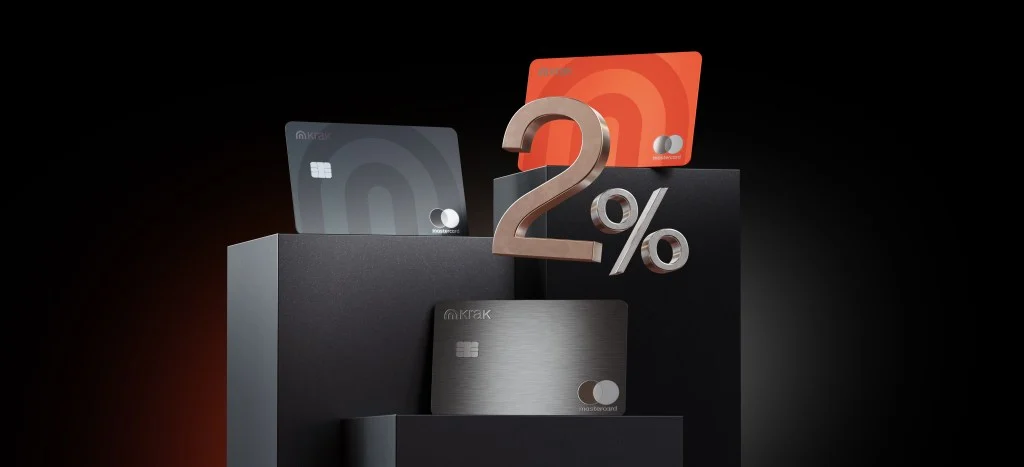
Krak announced its Metal Mastercard on 31 March 2026 for eligible UK and European Economic Area customers. The stainless-steel card joined the existing plastic and virtual options. The launch linked qualification to an average £50,000 or €50,000 held across Krak, Kraken and Kraken Pro.
The announcement promoted 2% cashback while stating that the rate depends on average assets and geographic conditions. It also disclosed conversion spreads and possible third-party ATM fees. The new physical format therefore came with a financial qualification, rather than simply a one-time purchase price for a heavier card.
[1]A balance average behaves differently from a balance snapshot
Krak's rewards documentation explains that a deposit contributes progressively to a thirty-day average. It also says the reward rate for a purchase depends on the tier when the merchant settles the transaction. That separates three things a customer might otherwise confuse: the balance visible today, the balance used for qualification and the moment a purchase earns its final rate.
The July-updated guide includes a £50,000 or €50,000 average at its highest listed tier. These later programme details help explain the mechanism. They should not be used to imply that every metal-card customer will retain the launch rate indefinitely or that moving funds for a single day establishes the same average as holding them throughout the period.
[2]What the premium format changes for a decision
A metal card is a tangible object, while its qualification is an ongoing account condition. Those two aspects should be valued separately. Someone who likes the design may judge its weight and appearance differently from someone primarily interested in rewards. Neither preference tells them whether keeping a larger balance in the associated accounts fits their intended use of the money.
The question is especially concrete when the required balance is much larger than monthly spending. A customer can admire the card while deciding that daily purchases do not justify changing where substantial assets are held. Another customer may already meet the qualification and therefore face a much smaller practical decision about which physical format to order.
An illustrative thirty-day balance calculation
Imagine an account with a constant €20,000 balance for fifteen days and €60,000 for the next fifteen. A simple equally weighted average over those thirty days is €40,000: half the period at the first amount and half at the second. The final visible balance is €60,000, but the period's average is lower.
Now imagine the €60,000 balance was present for only one day, after twenty-nine days at €20,000. The same simplified calculation gives about €21,333. A large last-day deposit changes the snapshot much more than the average. These are original arithmetic examples, not a reconstruction of a particular Krak account or its daily valuation process.
The examples explain why timing belongs in the decision. A person planning a trip next week cannot infer a qualifying average merely from the amount available to deposit today. Market movement, withdrawals and the programme's actual measurement rules would all need to be reflected in the real account calculation.
Put the reward difference beside ordinary spending
Suppose, for illustration, a customer expects €1,500 of eligible monthly purchases. At an assumed 2% rate the gross reward would be €30. At an assumed 1% rate it would be €15. The difference is €15 for that month. Neither number includes conversion costs, excluded purchases or changes to the person's actual tier.
That comparison helps give the headline a scale. A percentage can sound substantial without showing how much money it represents for the user's normal budget. The relevant amount is the incremental benefit from purchases the customer already intends to make, rather than a reason to invent more spending.
The Metal launch added a premium option for customers with larger balances in the Kraken ecosystem. Its practical value depends on the relationship between an individual's existing holdings, preferred card format and ordinary purchases. The launch should remain a dated explanation of that option, with qualification and ongoing reward terms treated as conditions to verify rather than permanent properties of the metal itself.
Dates to know
As announced by the provider. A listed date does not confirm current availability or eligibility.
- Metal card launchDate passed[1]
Calculate a simple balance average
An original hypothetical exercise. Select a case.
| Case | What it means |
|---|---|
| Fifteen days each | €40,000 average Assume fifteen days at €20,000 and fifteen at €60,000, with equal daily weights. |
| One high-balance day | About €21,333 Assume twenty-nine days at €20,000 and one at €60,000. This is arithmetic, not an account-tier calculation. |
Illustration only; it does not check an account or predict a result.
Official sources & further reading
Independently written from the primary sources below. Checked on 26 September 2026.
- Put more weight behind every purchase: Announcing the Krak Metal Debit Card ↗Announcement · 31 March 2026
- Krak Card Cashback Overview ↗Documentation
20% off Kraken trading fees
The code discounts exchange trading. Krak cashback is a separate card benefit with its own terms.
Permanent code and partner link. Campaign dates and benefits are separate.
We may earn a commission, at no extra cost to you. Account and country conditions apply.