US balance requirements and cashback rates change on 15 October 2026. The change is not yet effective.
[2]At a glance
- What changed
- US card launch.
- Who it affects
- Prospective US cardholders.
- When
- 18 August 2026
Krak discount code and conditions ↓
Krak launched a US debit card with cash or Bitcoin rewards
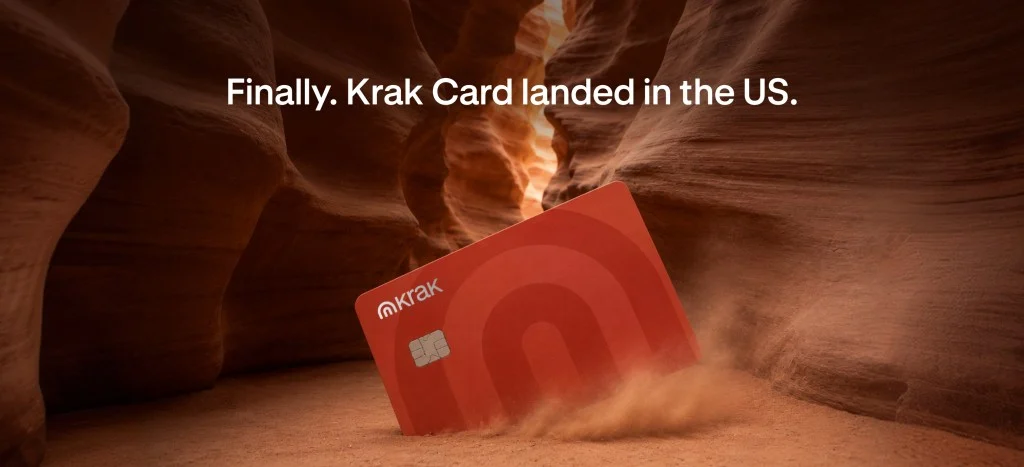
Krak introduced its US card on 18 August 2026. Lead Bank issues the Visa debit card, with Stripe supplying the card technology. The launch offered rewards in dollars or Bitcoin and spending from more than 600 supported balances. Customers could choose which holdings funded purchases and use a mobile wallet before a physical card arrived.
The product spends an existing balance rather than extending a conventional credit-card borrowing limit. The launch's reward headline was up to 2%, not a universal rate promised to every account.
[1]Who could apply and what approval meant
The US setup guide limits the card to verified personal accounts and excludes residents of New York, Maine, Massachusetts and Indiana at launch. Verification includes a Social Security number and independent checks by the issuer and programme manager. An existing app login should therefore not be confused with completed card approval.
The guide describes separate virtual and physical setup, a limit of three virtual cards in a rolling thirty-day period, and a $200 balance condition for a physical card. It also states that Krak Everyday is not a bank deposit account and its balance has no FDIC insurance. Lead Bank's role as issuer does not extend deposit insurance to that app balance.
[3]The date that determines cashback is settlement
Krak's US rewards guide bases tiers on a thirty-day average across Krak, Kraken and Kraken Pro. The applicable rate is fixed when the merchant settles the transaction, which can occur after the initial authorization. Refunds, cash withdrawals and other excluded transactions do not create ordinary purchase cashback.
Checked on 26 September, the guide announces higher balance requirements and adjusted US rates from 15 October 2026. That change is still in the future. This article does not infer the new tier table from the August launch or describe the old maximum as a permanent entitlement.
[2]A hypothetical purchase with three different dates
Imagine a customer authorizes a $120 purchase on Monday. The merchant completes its payment record on Wednesday, and the customer reviews the transaction on Friday. Those three dates can serve different purposes: Monday records the shopping decision, Wednesday completes the merchant's payment, and Friday is simply when the customer looks.
For an illustrative reward calculation, suppose the applicable rate at completion is 1%. The reward would be $1.20 before any relevant adjustment. At an assumed 2% rate, it would be $2.40. The arithmetic does not establish which tier the customer actually has. It shows why comparing a pending display with a completed statement requires knowing which stage each number represents.
The same purchase can also change the composition of the account. Suppose the customer has chosen to spend dollars before any digital asset. An understandable statement should reveal what funded the purchase and what remained afterward. A reward is an addition to that record, not a substitute for understanding the underlying debit.
Choosing a reward currency changes what happens afterward
Assume an imaginary customer earns $10 and elects to hold the value in an asset whose market price moves. If the asset subsequently falls 10%, that holding would be worth about $9; if it rises 10%, it would be worth about $11. These are simple hypothetical changes after receipt, not predictions about Bitcoin or extra cashback supplied by Krak.
A dollar-denominated shopping budget and a preference to accumulate Bitcoin are different objectives. One customer may value a stable number of dollars for the next bill, while another prefers exposure to a changing asset price. Neither preference changes what the merchant charged for the original purchase.
For someone deciding whether to use the US card, the sequence is therefore concrete: establish eligibility, understand the available spending balance, select which holdings may be used, and review the settled transaction. The upcoming October change adds a dated reason to revisit the reward assumptions. The launch remains a meaningful expansion of access, while the account's actual terms determine the value of a purchase made today or after that future date.
Dates to know
As announced by the provider. A listed date does not confirm current availability or eligibility.
See the announcement calendarSeparate a reward from later price movement
An original hypothetical exercise. Select a case.
- Value falls 10%
$9 remains
Assume $10 of reward value is held in a changing asset. A later 10% fall leaves $9.
- Value rises 10%
$11 remains
Under the same invented starting value, a later 10% rise gives $11.
Illustration only; it does not check an account or predict a result.
Official sources & further reading
Independently written from the primary sources below. Checked on 26 September 2026.
- Krak Card launches in the US: up to 2% cashback, 600+ currencies ↗Announcement · 18 August 2026
- US Krak Card Cashback Overview ↗Documentation
- Getting Started with US Krak Card ↗Documentation
20% off Kraken trading fees
The code discounts exchange trading. Krak cashback is a separate card benefit with its own terms.
Permanent code and partner link. Campaign dates and benefits are separate.
We may earn a commission, at no extra cost to you. Account and country conditions apply.