From the archive. This story describes the announcement at its original publication date. Product availability, pricing and terms may have changed.
At a glance
- What changed
- Rebuilt social-intelligence platform.
- Who it affects
- Researchers and data-tool builders.
- When
- June launch; access documentation checked September 26.
LunarCrush partner offer and conditions ↓
A rebuilt interface for following social activity
LunarCrush launched its rebuilt platform on 9 June 2026 with personalized discovery, activity insights, alerts and custom collections. Its announcement says existing accounts and saved research remain available. The interface and developer tools use the same data, connecting visual exploration with recurring research.
[1]Posts, interactions and creators count different things
The official API reference defines the topic response as an aggregation over the latest 24 hours, with comparisons to the preceding period. It separates posts that received interactions, the interactions themselves and unique contributors. Interactions include measurable activity such as views, likes, comments and shares. Its sentiment measures weight posts by interactions, rather than giving every author one equal vote. The response also records when the data was generated. Those definitions matter when turning a dashboard number into a sentence about what happened.
Consider a fictional discussion containing ten posts by two people, with a combined thousand reactions and views. Calling that a thousand people talking would confuse activity with participation. Calling it ten newly published posts could also be wrong if the count refers to older posts receiving fresh activity. A useful report names the measure actually observed and its time window. The same underlying discussion can legitimately produce different counts without any of those counts describing a thousand separate opinions.
[3]Read a rank differently from a score
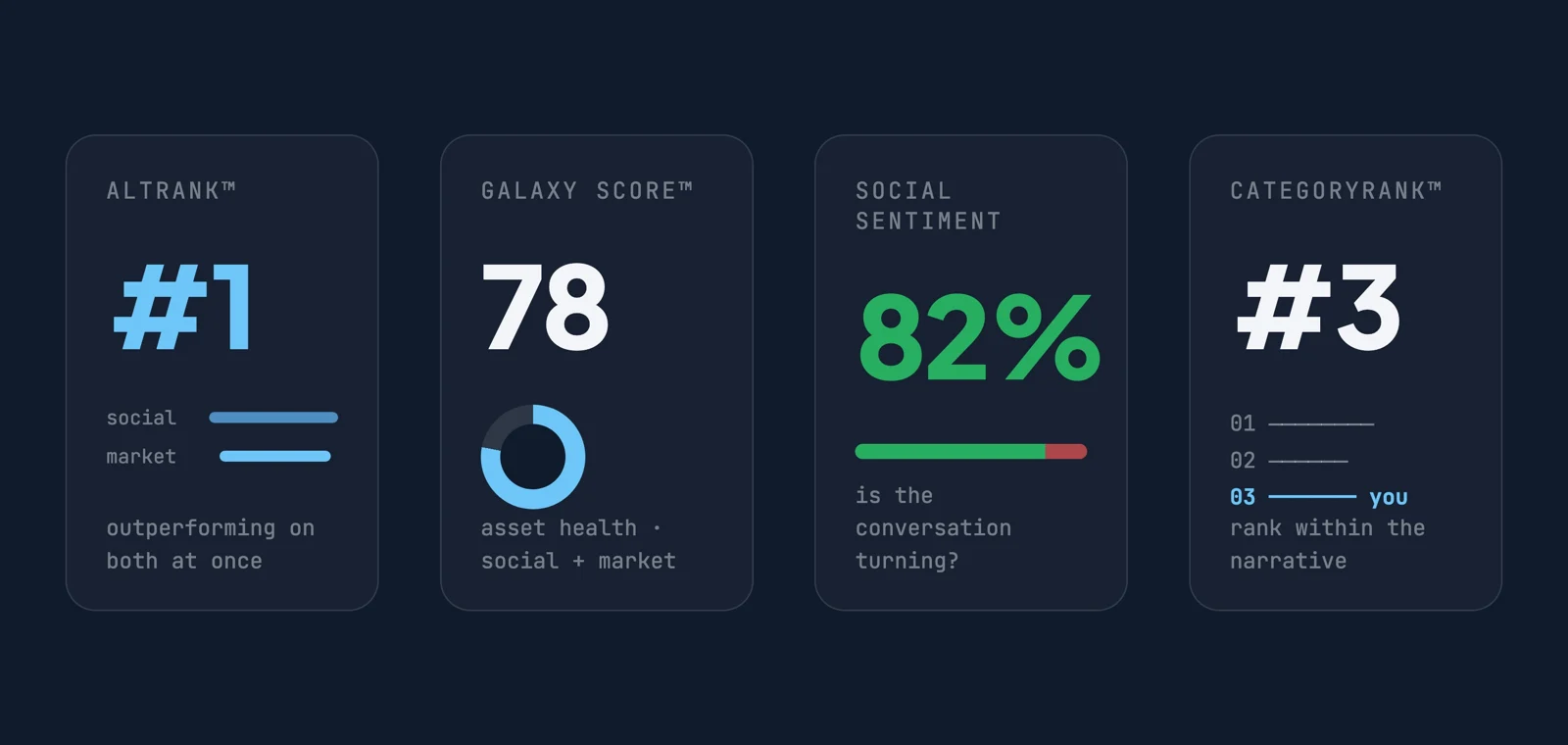
LunarCrush describes AltRank as a relative ranking that combines social and market momentum; first place means the strongest position within the tracked comparison set at that moment. Galaxy Score is instead a zero-to-one-hundred composite of social activity, sentiment and market momentum. They answer different questions, even when both appear beside the same asset.
For an original example, moving from tenth to fifth place says something about relative position. It does not state that activity doubled. A score moving from forty to fifty is another kind of change and should not be rewritten as a ten-place climb. Neither observation, on its own, explains whether the underlying discussion concerns a successful launch, a complaint or an outage. Open the relevant posts before assigning a cause.
[4] [5]Choose the interface that fits the research task
The release describes three developer routes. An application programming interface, or API, lets software request structured data. The command-line interface, or CLI, lets a person make queries through a terminal and pass results into a script. Model Context Protocol, or MCP, provides the connection through which a compatible AI assistant can use LunarCrush data as a tool.
The current API guide documents encrypted HTTPS requests with an API key, a private access credential, and responses in JSON, a format software can read. It lists separate routes for tracked coins, a topic's posts and a category's creators. This gives a builder concrete choices: retrieve the asset list for comparison, open the posts behind a subject, or examine who contributes to a category. The tool chosen should follow that question rather than simply collect every available field.
[1] [2]Access and request limits still shape an automated monitor
The API documentation checked on 26 September says requests consume both per-minute and daily allowances. Endpoint access depends on the subscription tier. The free Hobby tier covers market-data endpoints; social, creator and AI access requires paid plans. An API key therefore does not by itself establish access to every data category. These are current documentation details, not a claim that every June launch feature was free.
Suppose a proposed monitor makes six separate requests each hour. Continuous operation would produce 144 calls per day before retries or extra investigations. Doubling the refresh frequency doubles that planned count to 288. These invented workloads are useful for comparing a design with the relevant allowance, but they do not show that six subjects necessarily require six calls: a response may already contain several useful items. Count the requests the design actually makes.
[2]Turn a social alert into a verifiable news lead
For an exchange-news editor, an alert about a surge in discussion should begin an investigation, not publish a conclusion. Open the posts, identify the specific claimed event and locate the provider's own announcement. A popular complaint, reposted campaign or rumor can all increase attention. Keep the observed social movement separate from the official fact ultimately reported. That distinction makes the rebuilt discovery tools useful without treating popularity, a score or an AI summary as independent confirmation of a product change.
Dates to know
As announced by the provider. A listed date does not confirm current availability or eligibility.
- Rebuilt platform launchDate passed[1]
What does the observed number tell you?
Separate measurement from the conclusion you plan to write.
- Activity increased
Identify what was counted
Compare posts, interactions and contributors before describing the size of the discussion.
- A ranking improved
Describe relative position
A better place in a comparison is not a percentage growth rate.
- A campaign is trending
Find the official announcement
Use the social signal as a lead, then verify the actual offer and timing with the provider.
Illustrative reading exercise. It does not validate a live signal or predict prices. [3] [4]
- New discovery interface.
- Shared data for software and AI tools.
- Metric definitions affect interpretation.
Official sources & further reading
Independently written from the primary sources below. Checked on 26 September 2026.
- The New LunarCrush Platform Is Live ↗Announcement · 9 June 2026
- LunarCrush API guide: access and limits ↗Official documentation
- LunarCrush API v4: topic and time-series field definitions ↗Official documentation
- LunarCrush: What is AltRank? ↗Official documentation
- LunarCrush: What is Galaxy Score? ↗Official documentation
Start with the free tier
CRUSH10 is a partner code with no extra user discount currently attached.
Permanent code and partner link. Campaign dates and benefits are separate.
We may earn a commission, at no extra cost to you. Account and country conditions apply.