At a glance
- What changed
- Live audio and replays.
- Who it affects
- Company researchers.
- When
- Announced 7 October.
TradingView welcome offer and conditions ↓
Audio beside results
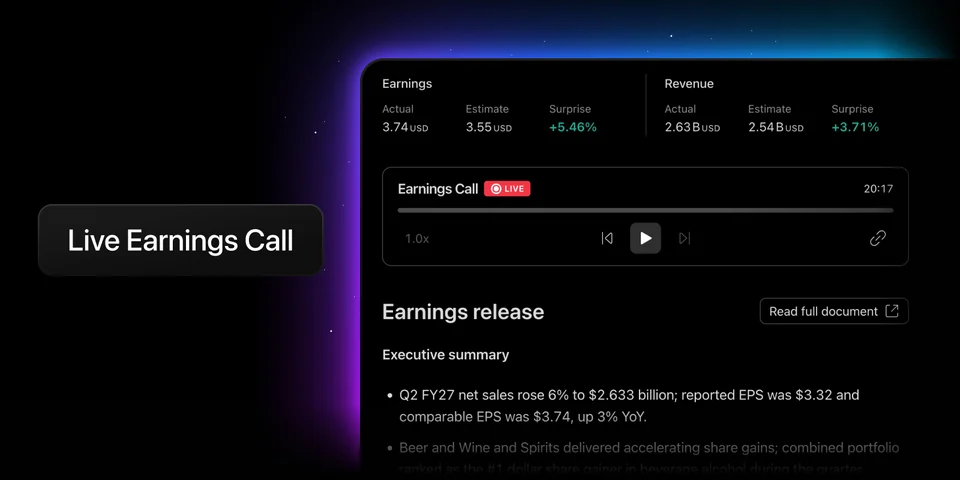
TradingView added live earnings calls and recordings on 7 October. These company briefings discuss results and include analysts’ questions. A player inside supported earnings documents lets stock researchers listen alongside written material. The announcement gives no complete coverage list or subscription requirements; access for every company or plan is not established.
Use the documents to check what you hear
TradingView introduced its Documents tab in October 2025. That earlier announcement describes searchable call transcripts, annual and quarterly financial reports, and investor presentations. These formats serve different reading tasks: a transcript helps locate a particular statement, while the underlying report supplies the written disclosure against which that statement can be checked.
The documented route starts on a stock’s symbol page, where Documents sits alongside the other company information. From a chart, the alternative route is Details, then Metrics, then Documents. The panel can follow a different company when the user changes symbols in a watchlist. That makes the selected symbol worth checking before comparing a statement with a chart.
For US companies, the collection can include annual 10-K and quarterly 10-Q filings. Presentation material also covers events such as investor days and shareholder meetings. This is background to the new listening feature; the document collection itself is not an October 2026 launch.
Match the commentary to the right earnings measure
TradingView’s earnings guide distinguishes earnings per share, or EPS, taken from a company’s release from a standardized measure. The reported figure can follow an adjusted methodology to make it comparable with analysts’ forecasts. The standardized figure uses a fully diluted accounting measure and appears when the full report is available. These labels can describe different measurements.
The estimate represents research analysts’ expectation for reported EPS. The surprise field compares the reported result with that expectation. An earnings marker on the chart belongs to the reporting date; it is not a measurement of the share-price return. The guide uses different marker colours and shapes for positive, negative, zero and unknown surprises.
When management mentions an adjusted result, matching that wording to the corresponding field avoids comparing it casually with a differently calculated number. If the distinction remains unclear, the recording alone does not resolve it: the written release and its definitions are the next evidence to examine.
An estimated report date is not a confirmed appointment
Timing needs a similar check before planning to listen. TradingView’s report-date documentation distinguishes exact dates obtained from companies or official sources from approximate dates calculated by its data provider. The approximate version carries the ≈ symbol. This label concerns publication of the earnings report; it should not be treated as a separately confirmed call start time.
The provider can estimate a date from the company’s reporting history. Without a clear pattern, its documented fallback is a Wednesday one month after the reporting period ends. If an estimate passes without a report, the date moves forward daily until results arrive or a confirmed date becomes available.
A moving estimate can thus reflect the calendar’s calculation rather than a company repeatedly postponing an announced event. For a researcher returning to an older quarter, keeping the reporting period separate from its publication date also prevents attaching a recording to the wrong set of results.
Turn listening into a specific research question
A useful way to approach a call is to write down one claim to investigate before pressing play. For example, a researcher could ask whether an executive is describing a result already achieved or an expectation for the next period. Those are different propositions even when they concern the same business activity.
After listening, record the claim and the passage that supports it, then compare that passage with the relevant document. This is a suggested reading method, not an automated TradingView assessment. It also keeps a clear boundary between observing a price move and explaining it: hearing a persuasive answer does not, by itself, establish why other market participants bought or sold.

30-day trial + $15 first-plan coupon
New-user eligibility applies. No code needed; check renewal pricing and coupon terms.
Conditions
The partner link has no expiry. Campaign dates, benefits and eligibility are separate and may change. Check the provider’s current terms before signing up.
We may earn a commission, at no extra cost to you.