At a glance
- What changed
- Two additional transaction categories.
- Who it affects
- People tracking awarded assets or account income.
- When
- Announced 13 October 2026.
TradingView welcome offer and conditions ↓
Two gaps in the transaction record
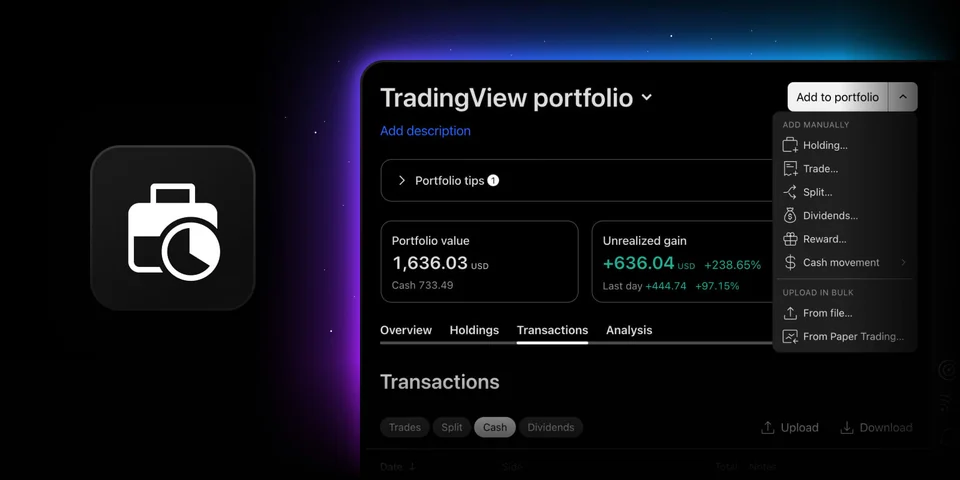
TradingView announced Reward and Income transactions for Portfolios on 13 October. The first records assets received without a purchase; the second records cash earned by the account. For people tracking employer stock awards, gifts or interest payments, these additions help the transaction history reflect how assets actually arrived. Both types support CSV import and export and count toward transaction limits.
Choose the entry by what changed
For a Reward entry, open the menu beside Add to portfolio, choose Reward, then enter the instrument, date and quantity. Quantity means individual units, even when the instrument normally trades in lots. A note of up to 128 characters can identify why the assets arrived. The entry increases the holding without reducing available cash or increasing invested capital, which is the money recorded as contributed to the portfolio.
Income has a different job. It increases available cash and contributes to realized gain and total return, but does not count as newly invested capital. A deposit increases the cash available for investment; it represents funding the account. This distinction matters when reconciling a statement: money contributed by the owner and money earned inside the account have different roles in performance measurement.
A dash is different from a zero return
A holding composed entirely of rewards has a zero recorded acquisition cost. Some percentage measures need an invested amount as their denominator, meaning the number they divide by. With no positive amount to divide by, TradingView displays a dash. It still shows absolute amounts, including unrealized gain. A missing percentage therefore does not mean the holding has disappeared or that its cash value is zero.
This affects the reward-only holding’s Unrealized gain %, Total gain % and Annualized yield in Holdings, as well as percentage performance in Analysis. The portfolio summary also suppresses Unrealized gain % and Annualized yield when every open position consists solely of rewards. A purchase at a nonzero price creates an invested amount and restores the applicable percentage calculations for the relevant period. These are the tracker’s calculation rules; the displayed acquisition cost should be understood in that product context.
Prepare the import before uploading it
CSV is a plain-text table whose columns are separated by commas. TradingView’s import guide requires a header row and provides a sample in the upload window. An asset uses an exchange-and-ticker identifier, whereas a cash entry uses $CASH. For Reward, Qty holds the number of units; for Income, it holds the cash amount. Cash rows are recorded in the selected portfolio currency.
For reward rows, Fill Price must be blank or zero, and Commission must be blank. A different price or a populated commission field causes an import error. Closing Time must include a transaction date, although a time is optional. If a Status column is present, only Filled entries are included; without it, all entries are considered.
The preview shows the instrument count, transaction count and total commission. A format error identifies the problematic line and prevents transactions from being added. Exceeding the subscription’s instrument or transaction allowance prevents creation of the portfolio, so a valid file still has to fit its destination.
Check both capacity limits
The plan comparison checked on 14 October lists Basic as free, with one portfolio, 20 holdings and 2,000 transactions per portfolio. Essential allows three portfolios and 50 holdings each; Plus allows four and 75; Premium allows five and 100; Ultimate allows seven and 150. Each of those four paid tiers lists 5,000 transactions per portfolio.
The two limits answer different questions. Holdings capacity determines how many instruments the portfolio can contain. Transaction capacity determines how much activity can be recorded within it. Moving to a tier with more holdings therefore does not necessarily increase the transaction ceiling: all four paid tiers currently share that ceiling.

30-day trial + $15 first-plan coupon
New-user eligibility applies. No code needed; check renewal pricing and coupon terms.
Conditions
The partner link has no expiry. Campaign dates, benefits and eligibility are separate and may change. Check the provider’s current terms before signing up.
We may earn a commission, at no extra cost to you.