TrezorPartner offer
Open-source hardware wallets
Shop through this partner link to get open-source hardware wallets.
Affiliate link. We may earn a commission, at no extra cost to you.
At a glance
- What changed
- Trezor confirmed implants in three CryptoBilis-sold Safe 5s, released firmware 2.13.1 to block them and cut its reseller network by about 80%.
- Who it affects
- Anyone who bought a Trezor from CryptoBilis from March 2026 onwards, and Safe 5 owners generally.
- When
- Firmware 2.13.1 released 11 November 2026; findings published 12 November 2026.
Add Exchange.news as a preferred source on Google
What Trezor found
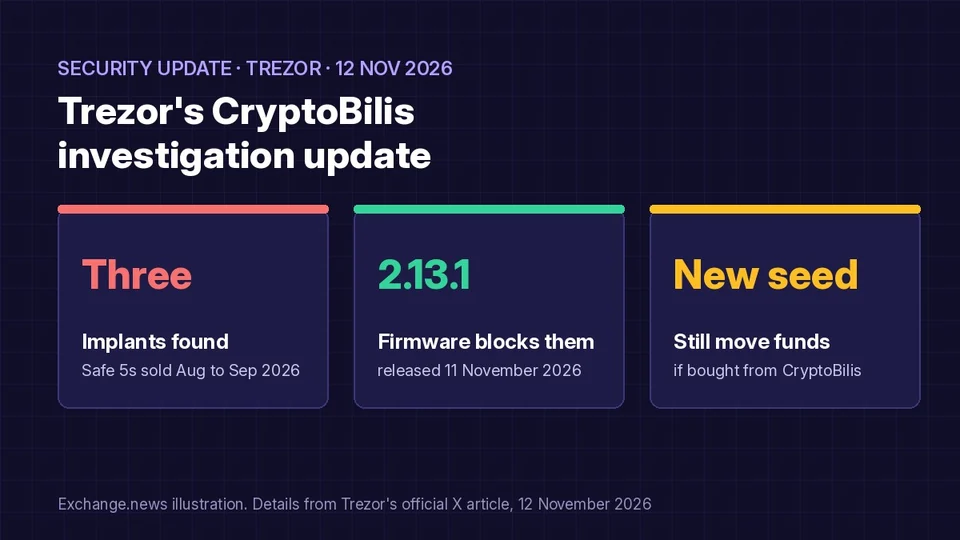
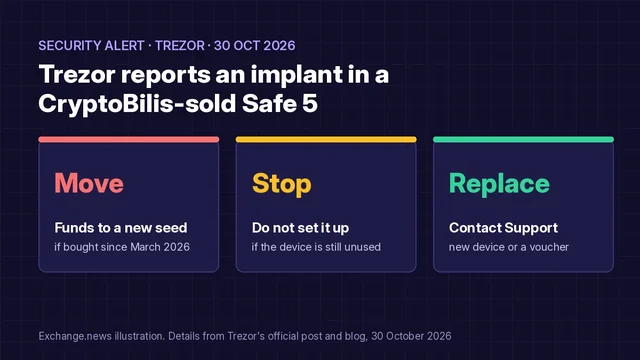
Trezor has published the follow-up it promised on the hardware implant reported in a Trezor Safe 5 bought from the reseller CryptoBilis. In an article on its official X account on 12 November 2026, Trezor said it has now found the implant in three Trezor Safe 5 devices bought from CryptoBilis, including the one first reported to it in October.
Its lab examined the originally reported device, and the other two were identified from photos of the internals sent by their owners. Trezor said all three were bought between 20 August and 23 September 2026, through CryptoBilis's Tokopedia and Shopee stores and directly from CryptoBilis. None of their owners has lost funds, and every other device checked showed no evidence of tampering.
After the October reports, Trezor asked CryptoBilis buyers to come forward, and 48 have done so so far. Trezor said it has also checked devices from its other resellers in the region and found no tampering, and that its investigation so far shows the implants are limited to Trezor Safe 5 devices bought from CryptoBilis between August and September 2026.
Firmware 2.13.1 and a smaller reseller network
Trezor said firmware update 2.13.1, released on 11 November 2026, includes a protection that stops the implants it has found from capturing anything on devices that run it, which it says makes the current batch of implants useless.
That does not undo earlier exposure. Trezor said CryptoBilis buyers should still move their funds to a new wallet with a new seed, because the update cannot protect a wallet backup that was captured before it was installed.
Trezor also said it has cut its reseller network by about 80%. It said the partners it removed were trustworthy and posed no immediate threat, but did not fit the much stricter processes every remaining reseller must now follow, covering how devices are sourced, stored and who has access to them.
How the implant works
Trezor's embedded team extracted and analysed the firmware from the implant in the reported device. Trezor describes it as an extra circuit board fitted between the Safe 5's main board and its screen that only listens: it copies everything shown on the screen, including what the owner types on the device, and does not change the device's firmware or Secure Element.
According to Trezor, whenever recovery words appear on the screen the implant recognises and stores them, both when the device shows a new wallet backup and when an existing wallet is recovered onto it. It does the same with a passphrase if one appears on screen. It encrypts what it captures and sends it over the mobile network to a server controlled by the attackers, retrying until it can connect. Trezor said it works the same way as the implants found in Ledger devices, adapted to the Safe 5's display.
Replacements and what to do next
Trezor says any customer who bought a Trezor from CryptoBilis from March 2026 onwards is eligible for a new Trezor device. Because of shipping rules it cannot deliver every model to every country, so in some cases it may offer a different model and refund the price difference, delivery to an address in another country, or a refund. Buyers should keep their CryptoBilis device and contact Trezor Support.
Trezor said it has no confirmed cases outside CryptoBilis. Owners unsure where their device came from can contact Support, and Trezor recommends buying future devices directly from trezor.io. Anyone who suspects tampering should keep the device and not set it up or use it until Support says what to do next.
Trezor said it is working with SEAL 911, the Security Alliance's emergency response service, will not publish technical details that could help attackers, and will add dated updates if it confirms an implant outside CryptoBilis or in another model, or any loss of funds. The customer who first reported the implant will be rewarded.
Our take
The firmware fix is good news for anyone who keeps a CryptoBilis-bought Safe 5 running, but it is not a substitute for a new seed. If your Trezor came from CryptoBilis, treat its recovery phrase as exposed, move funds to a freshly created wallet and then arrange the replacement. Expect scammers to pose as Trezor with replacement or refund offers: Trezor will never ask for your recovery phrase, and it says to deal with it only through its official support site.
Dates to know
As announced by the provider. A listed date does not confirm current availability or eligibility.
- Trezor releases firmware 2.13.1 with protection against the implants foundDate passed
- Trezor publishes its CryptoBilis investigation findingsDate passed

PhantomPartner offer
10% of trading fees back for 3 months
Phantom referral code: findcodes. Sign up with this code to get 10% of trading fees back for 3 months.
Affiliate link. We may earn a commission, at no extra cost to you.
Conditions
New users who sign up in the Phantom mobile app with this code get 10% of their own eligible trading fees back for three months from signup. Codes apply only at mobile-app signup and cannot be added later. Rebates are paid in CASH to the Phantom Cash balance after a $1 minimum; ID verification may be required. Perps and prediction markets are not available in every region; program terms apply and Phantom may change rates or end the program. Perps are unavailable in the US, UK and US-sanctioned jurisdictions; prediction markets are unavailable in the US, UK, Germany and sanctioned jurisdictions. Program eligibility depends on jurisdiction under the referral terms.
The code and partner link have no expiry. Campaign dates, benefits and eligibility are separate and may change. Check the provider’s current terms before signing up.
 Ledger