At a glance
- What changed
- Index-based scanning and a broader script selector.
- Who it affects
- Pine Screener users.
- When
- Announced September 1, 2026.
TradingView welcome offer and conditions ↓
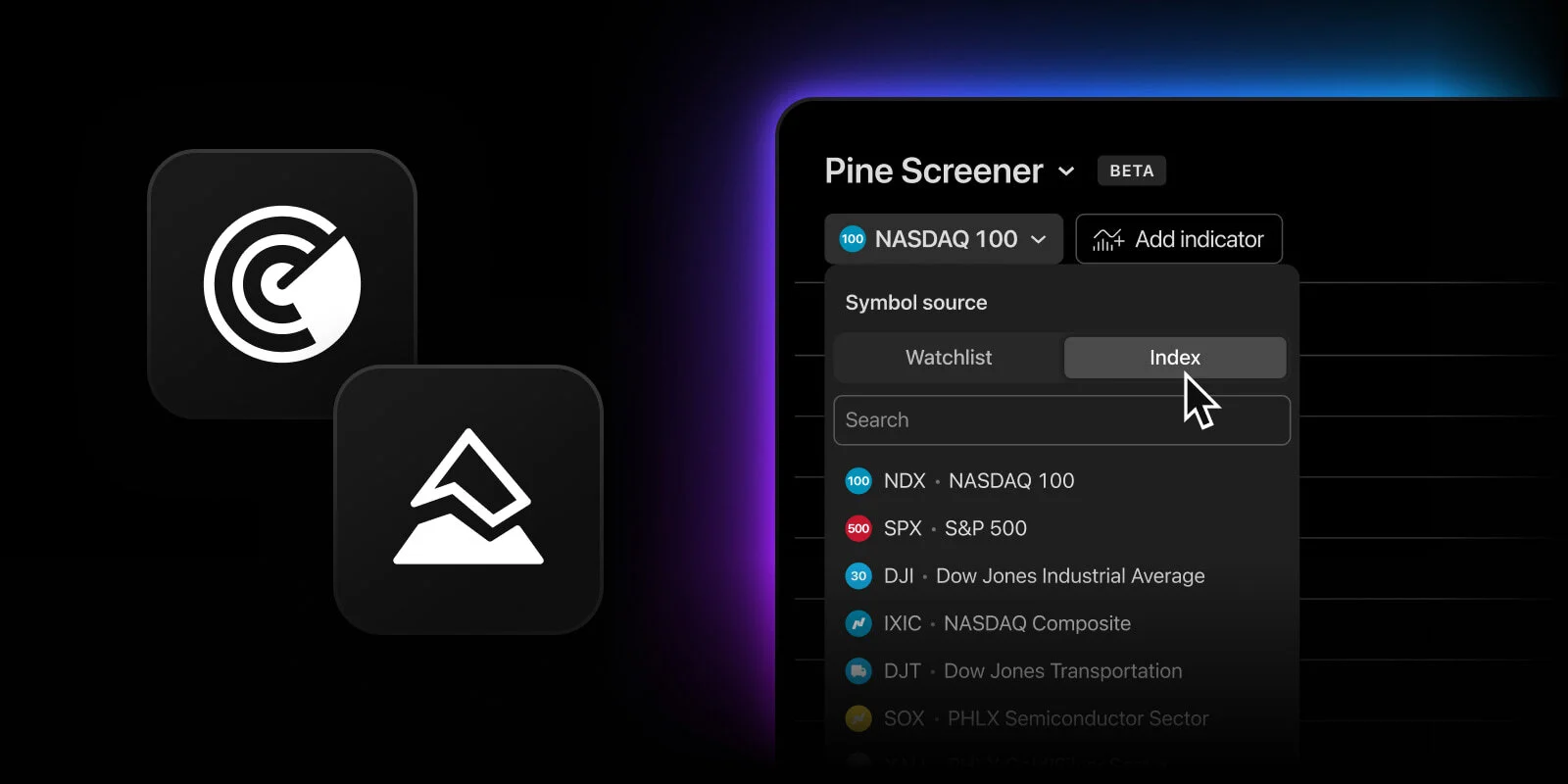
What the new source option changes
Pine Screener can now scan an index without a handmade watchlist and offers a script picker beyond favorites. Choose Index in the source selector, select an index and scan. Only one source can be active; changing it clears results but preserves the script, interval and inputs. A selectable script may still fail to execute.
This removes preparation work, but the reader still needs to understand the two parts of a screen: the group being examined and the test applied to that group.
[1]The source and the test are different choices
The official requirements guide describes a screen as a combination of a symbol source and one indicator. The source determines which instruments are examined; the indicator supplies the values or conditions used to examine them. The current guide limits calculations to the latest 500 bars and lists supported intervals rather than allowing arbitrary custom timeframes.
There is also a dated distinction in the documentation. The September announcement described index universes of up to 3,500 symbols, while the current requirements page states a maximum of 4,000. We preserve the announcement’s date and use the requirements page for present implementation detail. A historical launch description should not be mistaken for an unchanging specification.
[2] [1]A worked screening example
Imagine you want to find symbols where an indicator’s output is greater than 60. Begin with a fictional universe of five symbols whose results are 42, 58, 61, 73 and 85. Three meet the condition. The screen has answered a narrow question: which members of this selected group satisfy this calculation on the selected interval?
It has not ranked their businesses, verified the reason for the readings or established that buying them would be profitable. Those are separate questions. Keeping the initial result narrow is useful because you can reproduce it and identify exactly what would change if the filter or source changed.
Now replace the universe with another five symbols while retaining the same threshold. Suppose their outputs are 25, 39, 49, 52 and 59. No result passes. That outcome does not show that the indicator stopped working. It shows that this different group contains no observation above the chosen threshold in this invented example.
How to investigate an unexpected result
Before changing several settings, record the source, indicator name, interval and input values used in the first run. Then alter one item and rescan. If the result changes, you have a more useful clue about why it changed than you would after replacing the source, adjusting the threshold and changing the interval together.
For example, keep the five original outputs and change the threshold from greater than 60 to greater than 75. Only 85 remains. This is a direct consequence of a stricter rule, not evidence that the underlying symbols changed while you were working. The numbers here are teaching values, not a description of a live market or a particular published script.
When a script fails instead of returning an empty table, treat those as different outcomes in your notes. “No symbol passed the test” describes a completed test. “The test did not run” means the result is still unknown. Confusing those statements would make a research log much harder to trust.
Turning a scan into a readable research record
A useful note might say that a named universe was checked with a named indicator and threshold on a stated interval, followed by the number of matches. Add the time of the run and the next question you plan to investigate. Another reader can then understand the scope without having to reconstruct your entire screen.
The selector below shows how changing a threshold changes the matches in the same invented dataset. It does not execute Pine code or reproduce a live index. Use the new source option to reduce setup work, then spend the time saved on inspecting the actual matches. A smaller, explainable shortlist is more useful than a long list whose selection rule has been forgotten.
Change one screening assumption
Choose an illustrative case to follow the explanation.
| Case | What it means |
|---|---|
| Threshold 60 | Three matches Of 42,58,61,73,85, three invented values exceed 60. |
| Threshold 75 | One match Of the same five values, only 85 exceeds 75. The rule changed; the observations did not. |
Original learning exercise; no live market data or account action.
- A completed scan with no matches differs from a script that failed to run.
Official sources & further reading
Independently written from the primary sources below. Checked on 26 September 2026.
- Pine Screener: scan any index, pick any script ↗Announcement · 1 September 2026
- Current Pine Screener requirements ↗Official product documentation
30-day trial + $15 first-plan coupon
New-user eligibility applies. No code needed; check renewal pricing and coupon terms.
Permanent partner link. Campaign dates and benefits are separate.
We may earn a commission, at no extra cost to you. Account and country conditions apply.